Wednesday, 7 November 2012

M101 and NGC2903

M101, NGC5457. The Pinwheel galaxy. This galaxy is a face on spiral galaxy lying at a
distance of about twenty million light years in the constellation of Ursa Major. PHD auto
guiding software was used. A composition of five minute sub frames stacked with matching
dark frames to make a total exposure time of thirty minutes for each RGB colour filter:


NGC2903 . This barred spiral galaxy lies in the constellation of Leo at a distance of
about 30 million light years. Without autoguiding, 60 second sub frames were captured
making a total exposure times of twenty minutes for each colour filter. The sky conditions
were very clear on this particular evening with bright gibbous moonlight:


NGC7814 and NGC5985

NGC7814. This spiral galaxy looks similar to the Sombrero galaxy and lies deep in the
constellation of Pegasus at a distance of about 40 million light years. A 10", f/4.8 Newtonian was used.  Sub frames of 60 seconds were used without autoguiding . The total exposure time for each colour filter was forty minutes with matching dark frames:


NGC5985 . This group of galaxies is in the constellation of Draco . Without using an
auto guider, one minute sub frames were captured and stacked with matching dark frames . The total exposure time for each colour channel was thirty minutes:


Tuesday, 6 November 2012

The Virgo Cluster

This image of the Virgo cluster was taken through a ten inch, f/4.8 reflector using exposure
times of 90 minutes through a blue filter , 1 hour through a red filter and 40 minutes
through a green filter . Ten minute sub frames were used with matching dark frames:


Monday, 5 November 2012

The Jellyfish, IC59 and IC63

IC443 The Jellyfish nebula. This object is often overlooked. It lies in the southern
region of Gemini. A composition of ten minute sub frames making a total exposure time of
one hour for each filter was used. The filters were a Lumicon Night Sky H-alpha and an
Astronomik O111 filter:


This part of the night sky, the central region of Cassiopeia is challenging. It is full of
H Alpha and O111 regions of nebulosity. This image of IC59 and IC63 was taken using a two
hour exposure using a H-alpha filter for image luminance . The colour information was
combined with the luminance information with exposure times of 15 minutes for each RGB
filter:


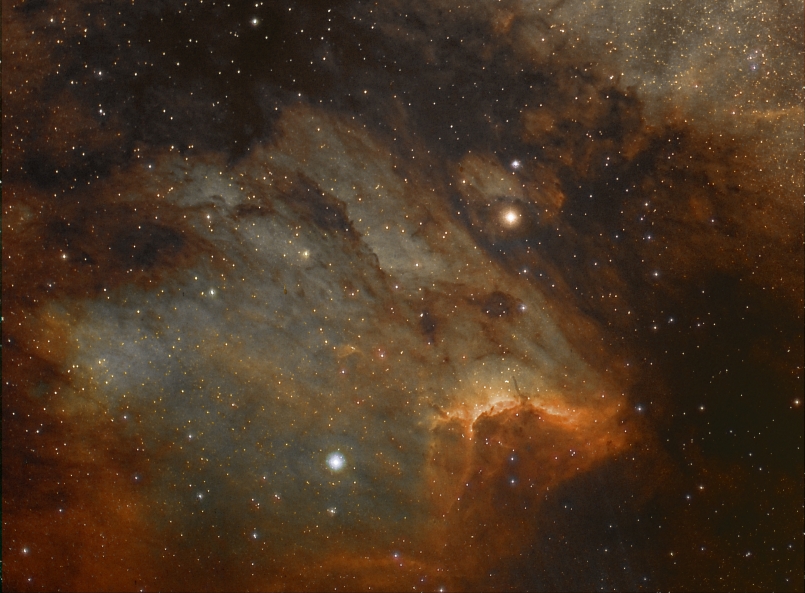
Bi-colour image of IC7050 The Pelican nebula

Here is an example of bi-colour imaging IC7050 The Pelican nebula taken using a focal
lenght of 640 mm. The sky conditions were very goodwith no moonlight so exposure times of
ninety minutes were used for each filter H Alpha and O111:


Sunday, 4 November 2012

The Crescent and Veil nebulae

NGC6888 the Crescent nebula. This image of the Crescent nebula was taken using a 4 inch refactor and PHD auto guiding software on a clear dark moonless night. A total exposure time of three hours was used with a H Alpha filter combined with twenty minute exposures with each of the RGB filters. 10 minute sub frames for all exposures combined with matching dark frames. This has pulled out the faint nebulosity from the sky background in the bottom of this image:


NGC6960 The Veil Nebula. This image reveals a large pecentage of the surrounding nebulosity within the Cygnus loop . A classic example of Bi-colour imaging , O111 was coloured red rather than green and H-alpha coloured blue rather than red. Ten minute sub frames were used. The total exposure time was ninety minutes for each filter:


The Rosette and Californian nebulae

This image of NGC2244, the Rosette nebula was taken using a blue filter combined with two narrow band filters O111 and H Alpha. The image here matches the focal length of the 4 inch refractor perfecty with a focal length of 642 mm. An exposure time of forty minutes was made using a blue filter and was combinded with 60 minute exposures using Olll and H-alpha narrowband filters:


This image of the California nebula is a mosaic of four images stitched together using Paint Shop Pro software.The data were collected on two seperate evenings, the H Alpha luminance data on one evening and the colour data on another. The sky was moonless and very clear with stars visible down to magnitude five which is good for city standards. The four luminance exposures were taken using 10 minute sub frames combinded with matching dark frames, a total exposure time of 90 minutes for each mosaic segment. On the second evening the sky conditions were very good but stars were only visible domn to magnitude 4.5. The exposure times were thirty minutes for each filter using 5 minute sub frames using the camera in x2 bin mode without including the dark frames. This image has a total exposure time of 12 hours:


Saturday, 3 November 2012

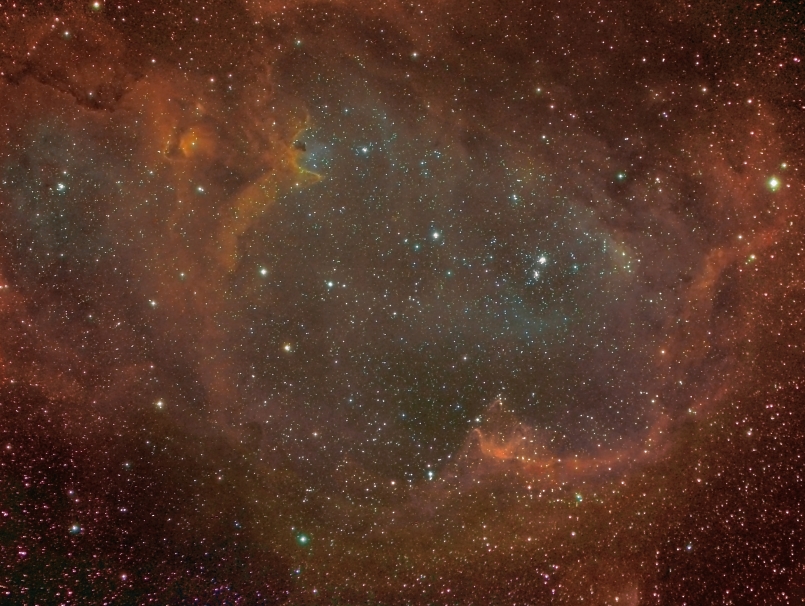
NGC 1805 The Heart nebula

NGC 1805 The Heart nebula taken using a 4 inch refractor with PHD auto guiding software 
This is a comparison between RGB and Bi-colour imaging . The first image was taken using
RGB Astronomik colour filters with exposure times of 40 minutes for each filter:


The second image is a composition of Bi-colour information combined with RGB colour
information but only using narrow band information for luminance . The narrow band
exposure times was 60 minutes for H Alpha and 90 minutes using an Astronomik Olll filter:


Thursday, 1 November 2012

The Makarion chain and the Andromeda galaxy

An example of wide field imaging: The Makarion chain, a realm of galaxies in Virgo . Exposure times were two hours using a blue filter combined with 40 minute exposures using red and green filters:


The next image is M31 the Andromeda galaxy using a 4 inch refractor . This image was taken using exposure times of sixty minutes for each RGB colour filter combined with a two hour exposure using a Lumicon H Alpha filter:


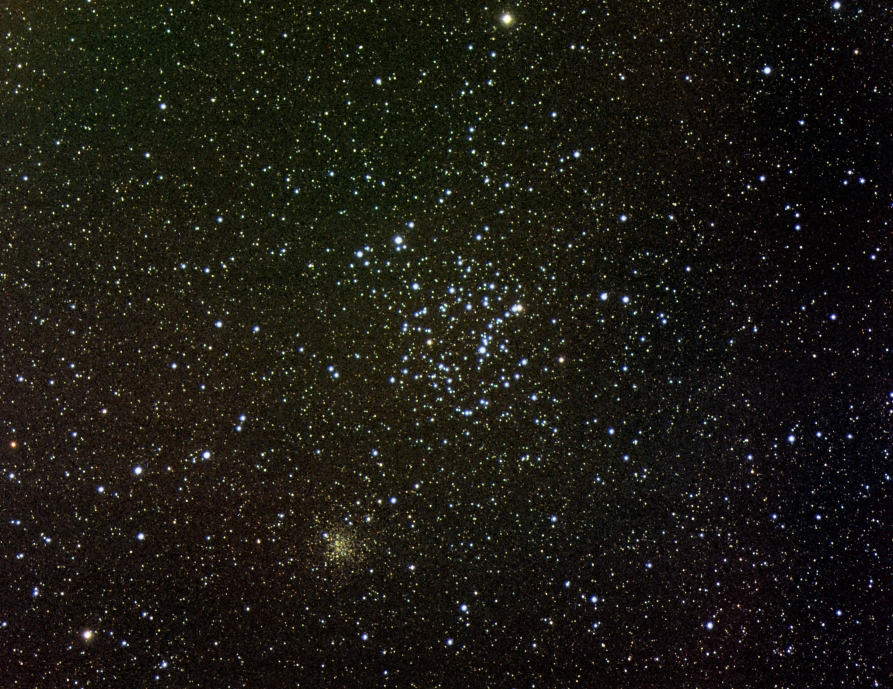
Open clusters M45 and M35

The image of M45 was made from exposures taken on two seperate evenings. The red and green colour channel exposure times were kept shorter than the blue . The exposure time for red and green was 30 minutes and the exposure time for blue was 4 hours .  This was because blue was used for image luminance to reveal the faint nebulosity .


For M35, the exposure times were five minutes for each RGB colour channel