
Sunday, 10 August 2014
M11 The Wild Duck Cluster
This open star cluster lies in the constellation of Scutum at a distance of about 6,000 light years.I was using my ten inch F4.8 reflector, an Atik 383L mono CCD camera with PHD auto-guiding. I captured five minute sub-frames with matching dark frames and combined them with flat field frames to reduce the effect of vignetting in the final composition. The total exposure times was 35 minutes in red, 20 minutes in green and 30 minutes using a blue filter:

Friday, 8 August 2014
NGC7331 in Pegasus
This spiral galaxy lies at a distance of about 40 million light years. Notice the number of surrounding galaxies including Stehans Quintet to the upper left. I took this image under very clear sky conditions with a first quarter moon to contend with. I was using my ten inch F4.8 reflector, an Atik 383L mono CCD camera with PHD auto guiding. I captured five minute sub frames and dark frames with flat field frames to reduce vignetting in the final compsition. The total exposure times were 50 minutes in blue, 30 minutes in green and 20 minutes using a red filter.


Thursday, 17 July 2014
NGC 7000 The North America nebula
This patch of nebuosity lies in the constellation Cygnus the swan . I was using a ten inch F4.8 reflector , PHD auto guiding and an Atik 383L mono CCD camera . I captured ten minute sub frames and matching dark frames and combined them with flat field frames to reduce vignetting in the final image . The total exposure times was 60 minutes using a H Alpha filter , 30 minutes using an O111 filter and 10 minutes for each colour filter:
Narrowband luminance with RGB colour:

Narrowband plus RGB:

Bicolour:

Narrowband luminance with RGB colour:
Narrowband plus RGB:
Bicolour:
Thursday, 3 July 2014
The Leo triplet
The Leo Triplet . Commonly named the M66 group in the constellation of Leo the Lion . It lies at a distance of about 30 million light years . This image was taken using an Atik 383L mono CCD camera, PHD auto guiding and a 4 inch F7 refractor with a focal reducer making it F 6.3. I captured ten minute sub frames with matching dark frames and combined them making total exposure times of sixty minutes for each colour filter:

Monday, 31 March 2014
NGC4565 and flat fields
This image of NGC4565 was taken under very clear sky conditions. It lies deep with in the constellation of Coma Berenices at a distance of about 42 million light years. Ay ten inch F4.8 reflector was used, with an Atik 383 mono CCD camera and PHD auto guiding. Astronomik RGB filters were used for the colour information with total exposure times of sixty minutes for each filter using five minute sub frames with matching dark frames. Flat field frames with matching dark frames were used for each filter. This reduces the effects of dust specks and vignetting showing on the CCD chip. The Flat field screen is shown on the end of the Newtonian:

This image shows an uncorrected and a flat field corrected image. Notice the correction for vignetting as a result of flat field correction.

The final processed image of NGC4565

This image shows an uncorrected and a flat field corrected image. Notice the correction for vignetting as a result of flat field correction.
The final processed image of NGC4565
Wednesday, 29 January 2014
M42 with much nebulosity
This image of M42 was taken under very clear sky conditions . Notice the surrounding faint nebulosity in the hydrogen alpha regions . An 80mm refractor was used , PHD auto guiding and an Atik 383L mono CCD camera . The total exposure times were 90 minutes using a H-alpha filter, 20 minutes using an O111 filter and ten minutes using RGB filters:

Sunday, 8 December 2013
The Cygnus loop
The Cygnus loop mosaic. This mosaic is a composition of two images stitched together using Paint Shop Pro.The eastern section (NGC 6992) has been included. Ten minute sub frames were used with matching dark frames, making total exposure times of 60 minutes using an Olll filter, 60 minutes using a H-alpha filter and ten minutes using each colour filter. An 80mm refractor was used with PHD auto guiding, with an Atik 383L mono CCD camera.
The Cygnus Loop

Labelled image

The Cygnus Loop

Labelled image

NGC6960
NGC6960 The Veil Nebula. This Image was taken under clear mooless sky conditions with only light pollution to contend with. A f/7, 80mm refractor was used, with PHD auto guiding and an Atik 383L monochrome CCD camera. Ten minute sub frames were captured with matching dark frames and then stacked them using Deep Sky Stacker. The exposure times were 120 minutes using a H-alpha filter, 80 minutes using an Olll filter. These narrowband exposures were used for the image luminance were as the RGB filters were used for the colour data. The exposure times were 20 minutes for each colour filter making a total exposure time of four hours and twenty minutes.
Narrowband image
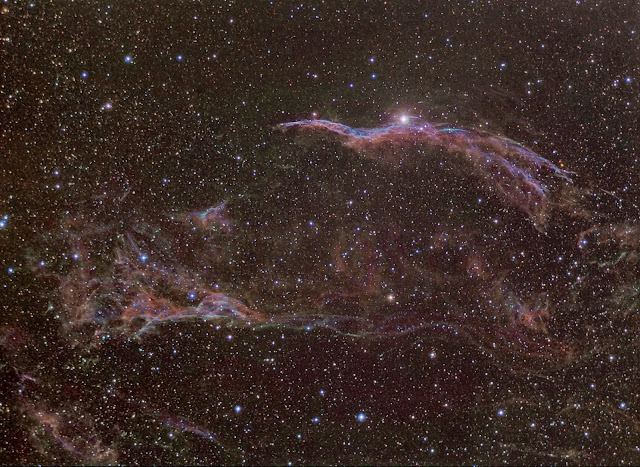
Bi-colour image

Combined images

Narrowband image

Bi-colour image

Combined images

Saturday, 23 November 2013
The Soul and Veil Nebulae
NGC 6960 The Veil Nebula.
This image was taken under clear bright moon light conditions. An 80mm refractor was used , PHD auto guiding , and an Atik 383L mono CCD camera . Ten minute sub frames were captured with matching dark frames.The exposure times were 80 minutes using a H-alpha filter, 30 minutes using an O111 filter and ten minutes for each [RGB] colour filter:

IC1848 The Soul Nebula.
This image was taken using a 80mm refractor , PHD auto guiding and an ATIK 383L mono CCD camera.Ten minute sub frames with matching dark frames were captured. The luminance exposure times were sixty minutes using a O111 filter and one hundred and twenty minutes using a H-alpha filter. These data were combined with the colour information captured using RGB filters with exposure times of twenty minutes for each filter:

This image was taken under clear bright moon light conditions. An 80mm refractor was used , PHD auto guiding , and an Atik 383L mono CCD camera . Ten minute sub frames were captured with matching dark frames.The exposure times were 80 minutes using a H-alpha filter, 30 minutes using an O111 filter and ten minutes for each [RGB] colour filter:

IC1848 The Soul Nebula.
This image was taken using a 80mm refractor , PHD auto guiding and an ATIK 383L mono CCD camera.Ten minute sub frames with matching dark frames were captured. The luminance exposure times were sixty minutes using a O111 filter and one hundred and twenty minutes using a H-alpha filter. These data were combined with the colour information captured using RGB filters with exposure times of twenty minutes for each filter:

Monday, 28 October 2013
IC1805 The Heart nebula
IC1805 The Heart nebula. This large exstended object lies in the constellation of Cassiopea the Queen.
This image was taken using an Atik 383L monochrome CCD camera and an 80mm F7 refractor with PHD auto-guiding. The exposure times were sixty minutes using narrowband pass filters (H-alpha and O111). Twenty minute exposures were used for each colour filter RGB filter. Five minute sub frames were used, combined with matching dark frames, making a total exposure time of 180 minutes.


This image was taken using an Atik 383L monochrome CCD camera and an 80mm F7 refractor with PHD auto-guiding. The exposure times were sixty minutes using narrowband pass filters (H-alpha and O111). Twenty minute exposures were used for each colour filter RGB filter. Five minute sub frames were used, combined with matching dark frames, making a total exposure time of 180 minutes.
RGB
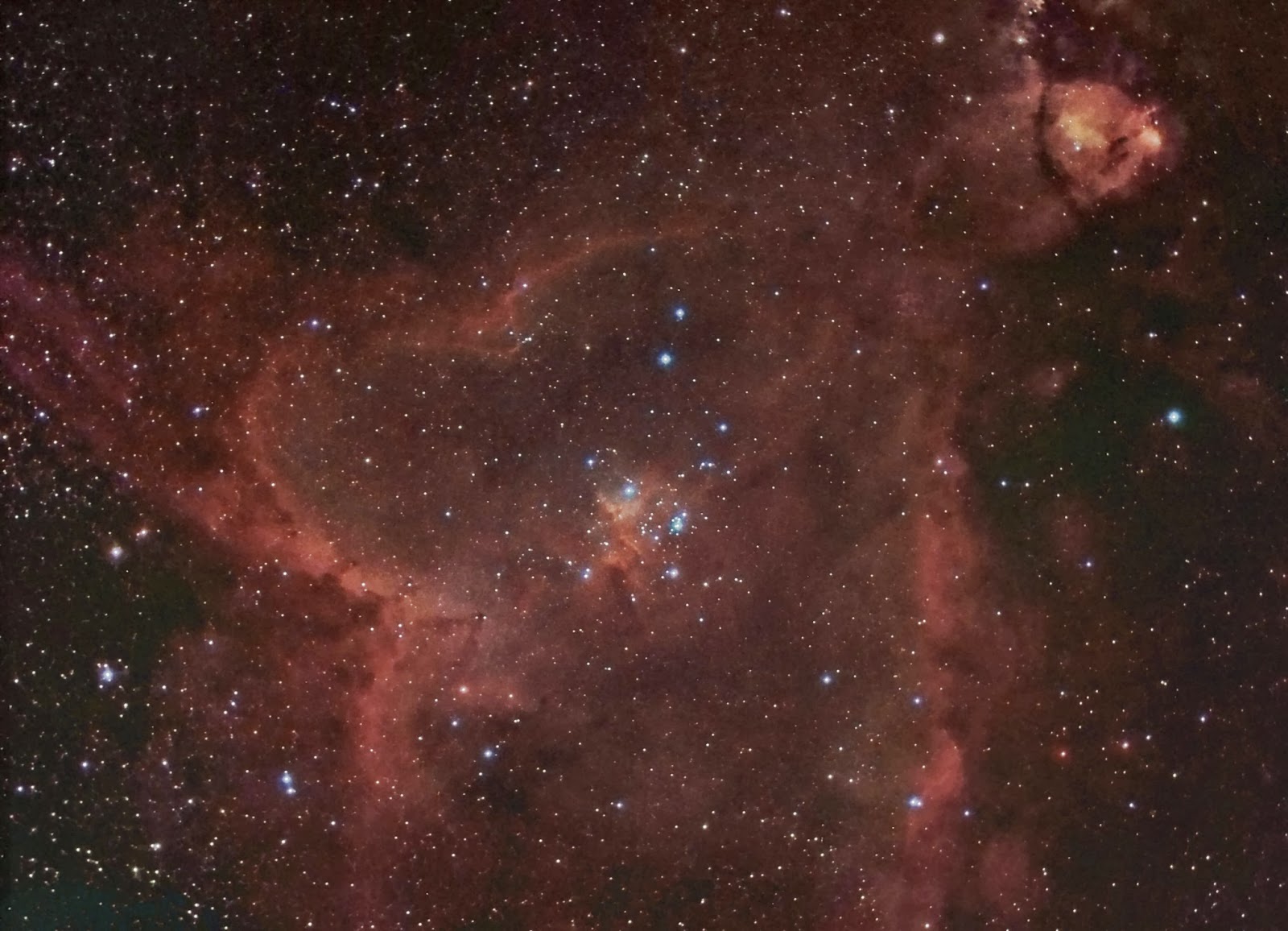
Narrowband

Narrowband + RGB

Subscribe to:
Posts (Atom)