Sunday, 24 January 2016

NGC1514, M31, M32 and M52

NGC1514, The Crystal ball nebula. This bright planetary nebula lies in the star constellation of Taurus the bull at a distance of about 600 light years. I was using my ten inch F4.8 reflector, PHD auto guiding and an Atik 383L mono CCD camera. I captured five minute sub frames with matching dark frames and combined them with flat field frames to reduce the effect of vignetting in the final image.The total exposure times was sixty minute using an O111 filter, twenty five minutes using a blue filter and twenty five minutes using a red filter.

NGC1514


M31 and M32. This image of M31 clearly show its dust lanes all the way in to the galaxy's core. I was using a ten inch F4.8 reflector, PHD auto guiding and an Atik 383L mono CCD camera. I used five minute sub frames combined with making dark frames and flat field frames to reduce the effect of vignetting in the final image. The total exposure times were twenty five minutes using a red filter, twenty minutes using a green filter and sixty minutes using a blue filter.

M31 and M32


M52. This open star cluster lies in the constellation of Cassiopeia the Queen, at a distance of about 6,000 light years. I was using my ten inch F4.8 reflector, PHD auto guiding and an Atik 383L mono CCD camera. I captured five minute sub frames and combined them with matching dark frames and flat field frames to reduce the effect of vignetting in the final image. The total exposure times were 20 minutes using a red filter, 20 minutes using a green filter and 60 minutes using a blue filter.

M52

Saturday, 3 October 2015

Total lunar eclipse and NGC7538

NGC7538. This deep sky wonder lies in the constellation of Cepheus at a distance of about 9,000 light years . This image was taken using a ten inch f/4.8 reflector , an Atik 383L mono CCD camera, with the addition of PHD auto guiding .I used five minute sub frames with matching dark frames and combined them with flat field frames to reduce the effect of vignetting in the final image . The exposure times was 60 minutes using a H Alpha filter , 25 minutes using a green filter and 20 minutes using a blue filter


28-9-15 Lunar eclipse. The images shown here was taken using a Cannon D50 DSLR camera in prime focus mounted on a ten inch f/4.8 reflector.


Monday, 11 May 2015

M85, NGC4394 and M106

M85 and NGC4394 . These to galaxies are located in the constellaton of Coma Berenices . M85 is an elliptical galaxy and NGC4394 is a barred spiral galaxy they both lies at a distance of about 60 million light years .This image was taken under poor sky conditions using a ten inch F4.8 reflector , PHD auto guiding and an Atik 383L mono CCD camera .I captured five minute sub frames with matching dark frames and combined them with flat field frames to reduce the effect of vignetting in the final image . The total exposure times was 40 minutes in the red, 30 minutes in the green and 25 minutes in the blue.


M106. This spiral galaxy lies in the constellation of Canes Vernatici however it is some times named NGC 4258. It lies at a distance of about 23 million light years shining at about magnitude 9. I was using a ten inch F4.8 reflector, PHD auto guiding and an Atik 383L mono CCD camera . I captured five minute sub frames with matching dark frames and combined them with flat field frames to reduce the effect of vignetting in the final image . The total exposure times was 50 minutes using a blue filter, 35 minutes using a green filter and 30 minutes using a red filter.


Saturday, 9 May 2015

Hubble's variable nebula and M100

NGC 2261 Hubble's variable nebula.This bright nebula lies in the constellation of Monoceros at a distance of about 2,500 light years. This image was taken under poor hazy sky conditions with bright moon light to contend with. I was using a ten inch F 4.8 reflector, PHD auto guiding and an Atik 383L mono CCD camera. I captured five minute sub frames with matching dark frames and combinded them with flat field frames to reduce the effect of vignetting in the final image.The total exposure times was 30 minutes using a red filter, 25 minutes using a green filter and 30 minutes using a blue filter.


M100. This face on spiral galaxy lies in the constellation of Coma Berenices at a distance of about 55 million light years. I was using my ten inch F 4.8 reflector, PHD auto guiding an an Atik 383L mono CCD camera. I captured five minute sub frames with matching dark frames and combind them with flat field frames to reduce the effect of vignetting in the final image. The total exposure times was 60 minutes using a blue filter, 40 minutes using a green filter and 35 minutes using a red filter.


Saturday, 28 February 2015

The Orion Nebula

M42. The Orion nebula.This image of the Orion nebula reveals a more natural colour composition. I used a ten inch F4.8 reflector, PHD auto guiding and an Atik 383L mono CCD camera. I captured five minute sub frames with matching dark frames and combined them with flat field frames to reduce the effect of vignetting in the final image. The total exposure times were 20 minutes using a red filter, 20 minutes using a green filter, 40 minutes using a blue filter and 60 minutes using a H Alpha filter:


Sunday, 22 February 2015

B33 and C/2014 Q2 Lovejoy

This image has been reprocessed in Astro art using a rotation filter [ Larson Sekanna ]. Notice the structure of the comet's jets.


B33 . This new image of the Horsehead nebula reveals more of its dynamic range in the colour data than the prevous images so far. I was using my ten inch F4.8 reflector, PHD auto guiding and an Atik 383L mono CCD camera. By capturing five minute sub frames, dark frames and flat field frames I reduced the effect of vignetting in the colour data in the final image. The total exposure times were 30 minutes in red, 30 minutes in green, 40 minutes in blue and 60 minutes in H Alpha.


Sunday, 18 January 2015

Comet Lovejoy C/2014 Q2

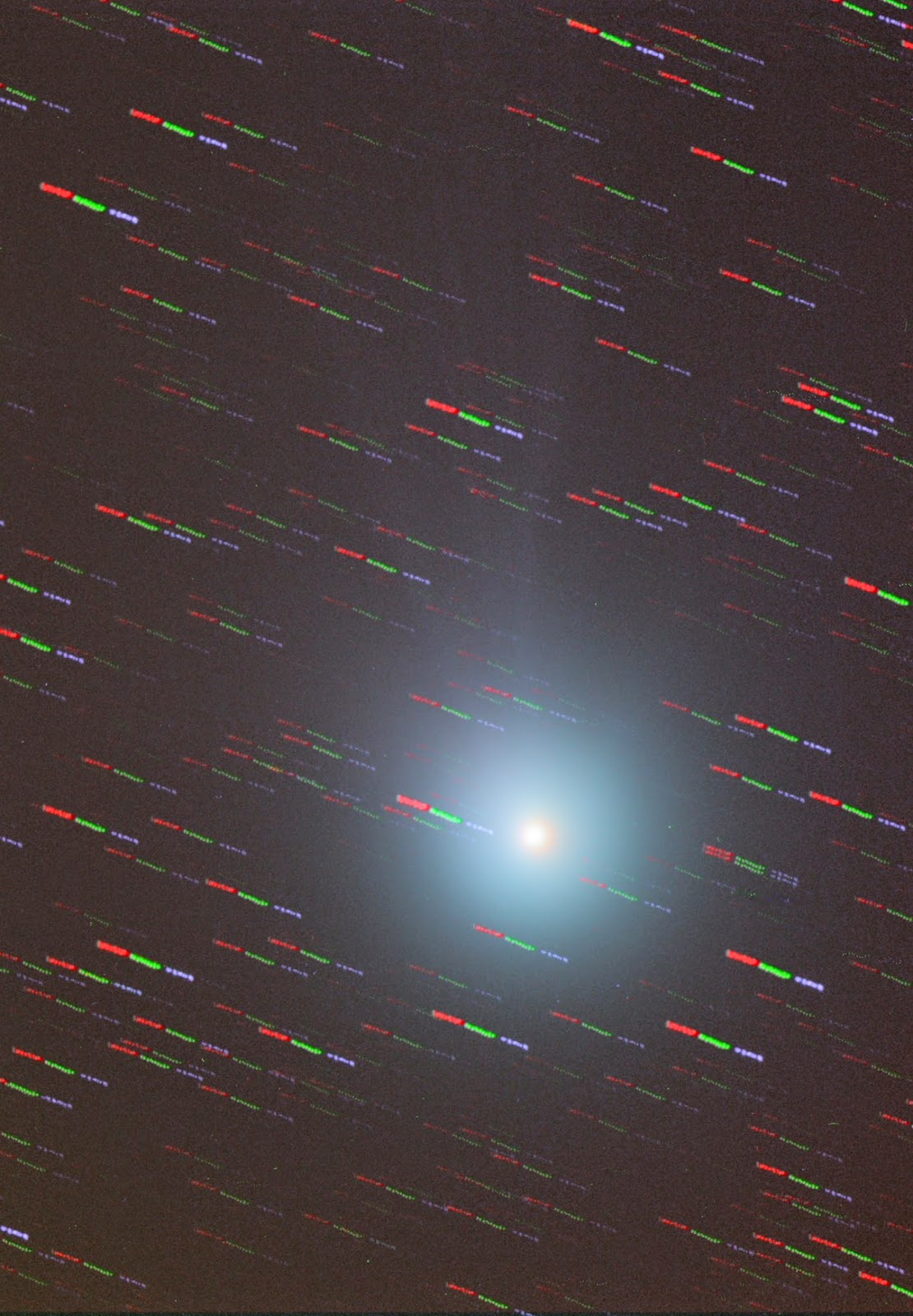
Comet Lovejoy . 16-1-15. This image was taken using a ten inch F5 reflector and an Atik 383L mono CCD camera. I only used a blue filter with a single two minute exposure with the camera set on x2 bin mode . I added the colour using Paint Shop Pro.


This image was taken using two minute subframes with matching dark frames and combined them with flat field frames to reduce the effect of vignetting in the final image .I was using my ten inch F4.8 reflector and an Atik 383L mono CCD camera . The camera was set on x 2 bin mode to increase the sensitivity .I used a blue filter to reveal the comets blue tail.


This image reveals the colours of the comet using RGB filters. Each colour channel had ten two minute sub frames and matching dark frames with the camera set on x 2 bin mode . This increased the cameras sensitivity by a factor of about four . I was using a ten inch reflector and an Atik 383L mono CCD camera.


Saturday, 10 January 2015

M35 and M45

M35. This open star cluster lies in the constellation of Gemini at a distance of about 2,800 light years . I took this image using a ten inch F 4.8 reflector , PHD auto guiding and an Atik 383L mono CCD camera . I captured five minute sub frames and matching dark frames and combined them with flat field frames to reduce the effect of vignetting in the final image . The total exposure times was 15 minutes using a red filter , 20 minutes using a green filter and 30 minutes using a blue filter .


Two section mosaic of M45 . This mosaic was taken using a ten inch F4.8 reflector, PHD auto guiding and an Atik 383L mono CCD camera .I captured five minute sub frames with matching dark frames  and combined them with flat field frames to reduce the effect of vignetting in the final image.The total exposure times was 20 minutes using a red filter , 40 minutes using a green filter and 100 minutes using a blue filter . I stitched the images together using Paint Shop  Pro software


Saturday, 27 December 2014

IC443 The Jelly fish nebula and NGC1435 Meropes nebula


IC443 The Jelly fish nebula. This patch of nebulosity is a supernova remnant that lies in the constellation of Gemini at a distance of about 5,000 light years. I was using my ten inch F 4.8 reflector, PHD auto guiding and an Atik 383L mono CCD camera. I captured five minute sub frames with matching dark frames and combined them with flat field frames to reduce the effect of vignetting in the final image. The total exposure times was ten minute fo each RGB filter, 15 minutes using an O111 filter and 60 minutes using a H Alpha filter . I used the narrow band data for the image luminance and the RGB data for the colour.


NGC1435 Meropes nebula.   Lying at a distance of about 450 light years this faint patch of nebulosity surrounds the 4th magnitude star Merope, located in the open star cluster M45 the Pleiades. It covers an area of sky about half a degree, the size of the full moon with a low suface brightness of about 15 - 16th magnitude . This image was taken under very clear sky conditions with only a cresent moon .I was using ten F4.8 reflector, PHD auto guiding and an Atik 383L mono CCD camera.I captured five minute sub frames and matching dark frames and combined them with flat field frames to reduce the effect of vignetting in the final image. The total exposure times was 20 minutes using a red filter, 40 minutes using a green filter and 100 minutes using a blue filter.


Tuesday, 16 December 2014

M29

M29. This open star cluster lies deep with in the constellation of Cygnus the Swan. I took this image under very clear sky conditions and bright full moon light. I was using a ten inch f/4.8 reflector, PHD auto guiding and an Atik 383L mono CCD camera. I captured five minute sub frames with matching dark frames and combined them with flat field frames to reduce the effect of vignetting in the final image.The total exposure times was 30 minutes for each RGB filter and 60 minutes using a H Alpha filter.