Saturday, 28 January 2017

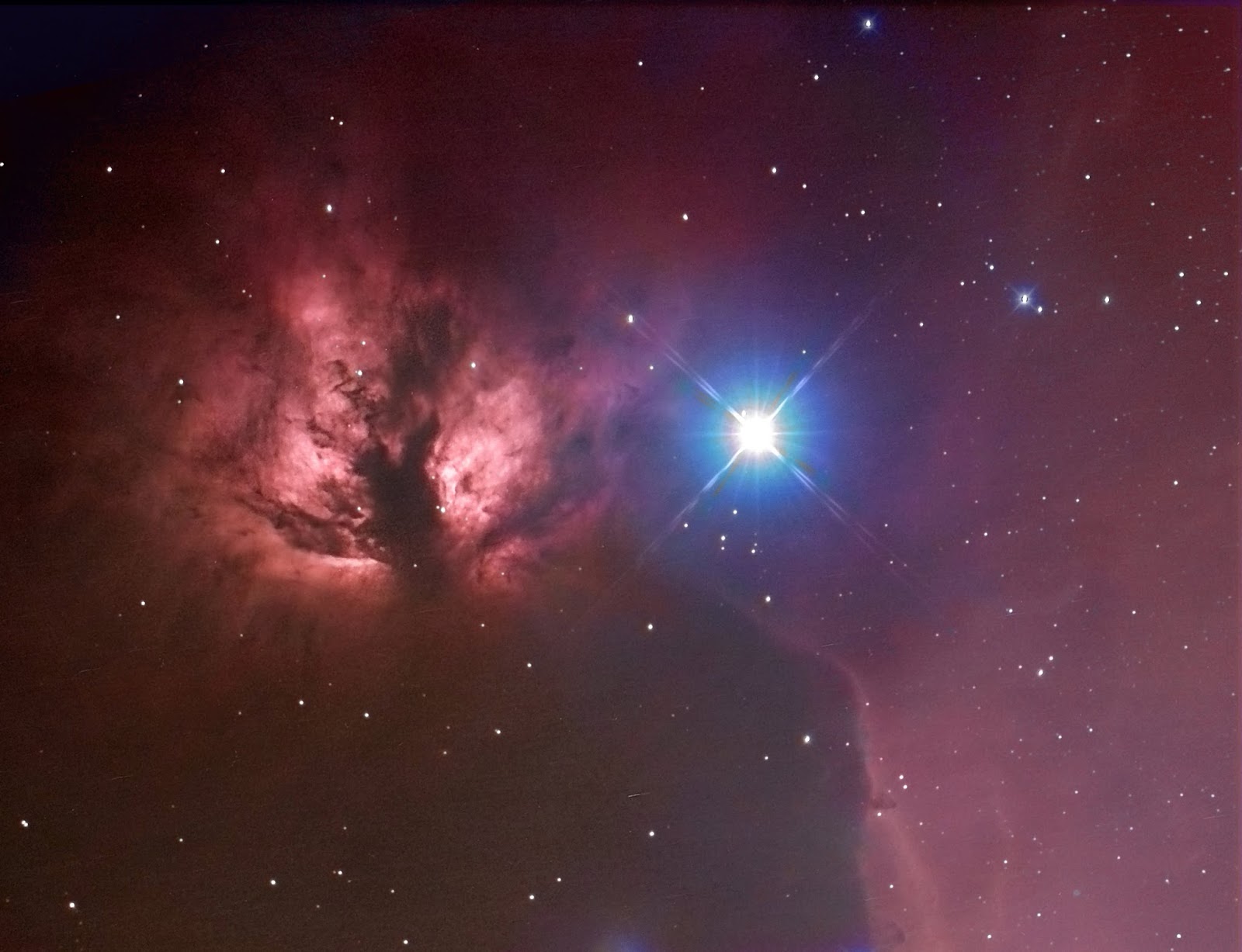
The Flame nebula

NGC2024 The Flame Nebula.
Within the constellation of Orion theHunter lies the Flame nebula next to the bright star Alnitak at a
distance of about 1,200 light years. The sky conditions on this particular evening was very poor with mist, fog and heavy light pollution to contend with. Stars was only visable down to about magnitude 3.5 so only narrow band imaging was posable. I was using my ten inch F4.8 reflector, an Atik 383L mono CCD camera and PHD auto guiding . I captured five minute sub frames with matching dark frames and combined them with flat field frames to reduce the effect of vignetting in the final image. In one of the images I used some old RGB colour data and combined it with new narrow band luminance data. The total exposure times was 60 minutes using a H Alpha filter, 30 minutes using a S11 filter and 30 minutes using an O111 filter. The colour data using the narrow band filters was H Alpha for green ,S11 for red and O111 for the blue, [ the Hubble palette ].

RGB


Narrowband


Narrowband + RGB


Sunday, 22 January 2017

NGC2174, the Monkey head nebula

NGC2174. This is commonly named the Monkey head nebula. This bright emission nebula lies in the constellation of Orion at a distance of about 6,400 light years. I took this image under heavily light polluted clear sky conditions with stars only visible down to magnitude 4. I was using my ten inch F 4.8 reflector, an Atik 383L mono ccd camera with PHD auto guiding. I captured five minute sub frames with matching dark frames and combined them with flat field frames to reduce the effect of vignetting in the final image. The hubble palette
was used for the image colour data using narrow band filters, S11 for red, HA for green and O111 for the blue. The total exposure times were 60 minutes using a S11 filter. 80 minutes using a H Alpha filter and 30 minutes using an O111 filter.


Saturday, 7 January 2017

The Soap Bubble Nebula

This cropped image is a combination of old and new data with the extra addition of two hours of H Alpha luminance. This makes a total H Alpha exposure time of three hours.
The Soap Bubble nebula

Comparison of the normal and negative image in which the soap bubble nebula is very clearly seen

Saturday, 31 December 2016

IC 405

IC 405. This object is commonly named the Flaming star nebula, SH2-229. It lies in the constellation of Auriga at a distance of about 1,500 light years. I took this image on a clear moonless night under heavy light polluted sky conditions. I was using my ten inch F4.8 reflector, PHD auto guiding and an Atik 383L mono CCD camera. I captured five minute sub frames with matching dark frames and combined them with flat field frames to reduce the effect of vignetting in the
final image. Some of the colour data is a combination of narrowband data and RGB colour data using S11 for red HA for green and O111 for blue. The total exposure times was 60 minutes for H Alpha, 30 minutes for S11 and 30 minutes for O111 filter. However the total exposure times for the RGB colour data was 20 minutes for each filter.


Monday, 5 December 2016

The Tadpole Nebula

IC410 . The Tadpole nebula.This emission nebula lies in the constellation of Auriga at a distance of about 10,000 light years. I took this image under clear moonless sky conditions using my ten inch f/4.8 reflector an Atik 383L mono CCD camera and PHD auto guiding. I captured five minute sub frames with matching dark frames and combined them with flat field frames to reduce the effect of vignetting in the final image. The total exposure times was sixty minutes using a H-Alpha filter, sixty minutes using an OIII filter, sixty minutes using an SII filter and twenty minutes using a blue filter.


NGC6888

These images of NGC6888 was taken on two seperate evenings. using R.G.B. and narrow band filters HA, OIII and SII . I was using my ten inch f/4.8 reflector an Atik 383L mono CCD camera and PHD auto guiding. I captured five minute sub frames with matching dark frames and combined them with flat field frames to reduce the effect of vignetting in the final image. The total exposure time was 40 minutes for each RGB filter, 60 minutes using a H Alpha filter, 30 minutes using an OIII filter and 30 minutes using an SII filter.


The Soap Bubble nebula

PN G75.5 1.7 The Soap Bubble Nebula. This is a very faint planetary nebula in the constellation of Cygnus the Swan. It lies near NGC6888 the Crescent nebula and was discovered in June 2008. Its low surface brightness is the reason why it was discovered so recently. I consider this planetary nebula to be very challenging for CCD imagers especially from a light polluted location. I took this image under clear, moonless sky conditions using my ten inch f/4.8 reflector, an Atik383L mono CCD camera with PHD auto guiding . I captured five minute sub frames with matching dark frames and combined them with flat field frames to reduce the effect of vignetting in the final image . Thetotal exposure times was sixty minutes using a H Alpha filter, forty minutes using an OIII filter and twenty minutes using a blue filter.


Sunday, 27 November 2016

IC 1805

IC 1805 .The core of the Heart nebula. The nebula lies in the constellation of Cassiopiea the Queen at a distance of about 7,500 light years . The sky conditions on this particular evening was not very clear , stars down to mag 4 was only visible . I captured five-minute sub frames with matching dark frames and combined them with
flat field frames to reduce the effect of vignetting in the final image. I was using a ten inch F4.8 reflector , an Atik 383L mono CCD camera with P.H.D. auto guiding . The total exposure time was sixty minutes for each narrow band filter , H Alpha, S11 and O111 filters using the Hubble palette for the colour data.


Wednesday, 9 November 2016

NGC281

NGC281 . This is commonly named the Pacman Nebula in the constellation
of Cassiopeia the Queen at a distance of about 9,500 light years . I
had bright moon light and light pollution to contend with, but with
very steady seeing conditions . The mount was tracking perfectly on
this particular evening , notice the inner core detail . I used five
minute sub frames with matching dark frames combined with flat field
frames to reduce the effect of vignetting in the final image. I was
using narrow band filters , S11, HA, and O111. and used the Hubble
Palette for the colour data. The total exposure times was sixty
minutes for S11 and HA filters and fourty minutes for the O111 filter


Detail in the core

Tuesday, 25 October 2016

NGC7635 The Bubble Nebula.

NGC7635 The Bubble Nebula.
This image of NGC7635 was taken using my ten inch F4.8 reflector, an Atik 383L mono CCD camera with PHD auto guiding. I used five minute sub frames with matching dark frames combined with flat field frames to reduce the effect of vignetting in the final image. I used the Hubble palette for the colour data using S11 for red H-Alpha for green and O111 for the blue. The total exposure times was sixty minutes for each filter.