IC5070 The Pelican nebula. This nebula lies in the constellation of Cygnus the Swan at a distance of about 1,800 light years, near NGC 7,000 The North America nebula. The sky conditions on this particular evening were very poor, it was hazy with a full moon, stars were only visible down to about magnitude 3.5. However narrowband CCD imaging was still possable. I was using my ten inch f/4.8 reflector with a Vixen Atlux mount, PHD auto guiding and an Atik 383L mono CCD camera.
I captured five minute sub frames with matching dark frames and combinded them with flat field frames to reduce the effect of vignetting in the final image. I used a set of Astronomik narrowband filters and used the Hubble palette for the colour data using SII for the red , H-alpha for the green and OIII for the blue channel . The total exposure times were 40 minutes for each filter.
IC1396 The Elephant trunk nebula. This dark nebula lies in the constellation of Cepheus the king at a distance of about 2,400 light years. I took this image under very clear, light polluted sky conditions with stars visable down to magnitude 5. I was using my ten inch f/4.8 reflector, a Vixen Atlux mount, PHD auto guiding and an Atik 383L mono CCD camera.
I captured five minute sub frames with matching dark frames and combinded them with flat field frames to reduce the effect of vignetting in the final image. The Hubble palette was used for the colour data using a set of Astronomik narrowband filters, SII , H-alpha and OIII filters. SII for the red channel, H-alpha for the green channel and OIII for the blue channel. The total exposure times for each filter was sixty minutes.
Monday, 15 January 2018
Saturday, 30 December 2017
NGC7000 and IC443, The Jellyfish nebula.
NGC7000 in narrowband with the Hubble palette
Here we have the wall section of the North American nebula, a star forming region in the consellation of Cygnus the swan. I captured five minute sub frames with matching dark frames and combinded them with flat field frames to reduce the effect of vignetting in the final image. I was using my ten inch F 4.8 reflector, a Vixen Atlux mount, PHD auto guiding and an Atik 383L mono CCD camera. The filters was a set of Astronomik SII, OIII and H Alpha narrowband filters with total exposure times of 40 minutes for each filter.
IC443 The Jellyfish nebula with the Hubble palette
This lies in the consellation of Gemini the twins. I was using my Ten inch reflector, a Vixen Atlux mount, PHD auto guiding and an Atik 383L mono CCD camera. I captured five minute sub frames with matching dark frames and combined them with flat field frames to reduce the effect of vignetting in thr final image. I was also using narrowband filters Astronomik SII, OIII and H Alpha filters with total exposure times of 30 minutes for each filter.Saturday, 16 December 2017
IC5146 The Cocoon nebula.
This reflection emission nebula lies in the constellation of Cygnus the swan. Unfortunately the clouds on this particular evening were closing in, I only had a total of about one hour and ten minutes of imaging time; therefore these images have more noise in them than some of my previous images. I captured five minute sub frames with matching dark frame and combined them with flat field frames to reduce the effect of vignetting in the final image. The telescope I was using was my ten inch F4.8 reflector, a Vixen Atlux mount, an Atik 383L mono CCD camera and PHD auto guiding. The exposure times were 35 minutes using a H-alpha filter , ten minutes using an SII filter, ten minutes using an OIII filter and fifteen minutes using a blue filter.
This final image of the Cocoon nebula has additional exposure of three and a half hours using a H-alpha filter. A total exposure time of four hours and forty minutes.
Bi-colour image
Narrowband
Hubble Palette
RGB Narrowband composite
This final image of the Cocoon nebula has additional exposure of three and a half hours using a H-alpha filter. A total exposure time of four hours and forty minutes.
Saturday, 9 December 2017
NGC 6992, The Eastern Veil nebula
I took these images on three separate evenings capturing five minute sub frames with matching dark frames , combined with flat field frames to reduce the effect of vignetting in the final image .The total of exposure times for each filter was sixty minutes using SII, OIII and H-alpha filters . I used for the colour data SII for green , OIII for blue and H Alpha for the red . I also had light pollution and moonlight to contend with , on one evening stars was only visible down to magnitude four . The telescope I was using was my ten inch F4.8 reflector , a Vixen Atlux mount with P H D auto guiding . The total exposure time in the final combined image was nine hours .
Wednesday, 29 November 2017
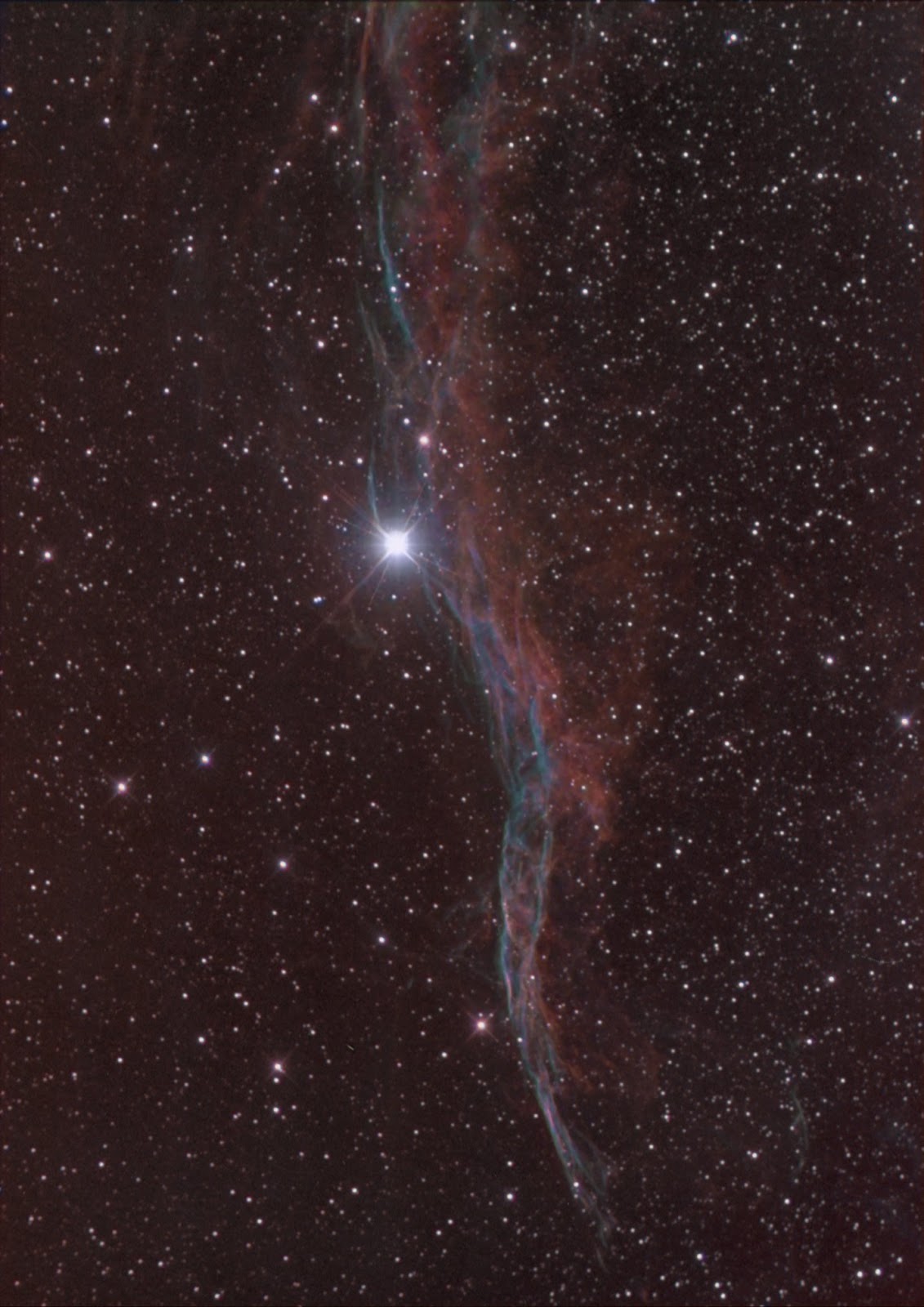
NGC6960 The Western Veil Nebula
NGC6960. The Veil Nebula: Commonly named the Veil nebula, the Cirrus nebula or the Witches Broom nebula. It lies in the constellation of Cygnus the swan shining at a low surface brightness of magnitude 7 at a distance of 1,500 light years. It was discovered back in 1784 by William Herschel. I took this image under heavy light pollution and a first quarter moon, the sky conditions was very clear however stars was only visable down to magnitude 4.5. I was using my ten inch F4.8 reflector.with an Atlux mount, an Atik 383L mono CCD camera and P.H.D. auto guiding. The exposure time was one hour for each narrowband filter, [ HA . O111 and S11 ] and forty minutes for each R.G.B. filter. I captured five minute sub frames with matching dark frames and combined them with flat field frames to reduce the effect of vignetting in the final image.
RGB
Bi Colour
Narrowband
Narrowband Unsharp Masked
Tuesday, 14 November 2017
M27
M27. The Dumbell Nebula. This image of M27 is a composition of new and old data taken on three seperate evenings . I used five minute sub frames with matching dark frames and combinded them with flat field frames to reduce the effect of vignetting in the final image . I used H Alpha as red, O111 as blue and S11 for the green , the total exposure times was 3 hours using a HA filter , 2 hours using an O111 filter , one and a half hours using a S11 filter and 30 minutes for each R.G.B. filter. A total exposure time of 8 hours.
RGB
Narrowband
Erode
Here we have the final composition of M27 the Dumbell nebula, notice the faint outer shells of gas expanding outwards. I used all of the narrowband data for the luminance and only a little RGB colour data to reveal the colour of the stars. The total exosure time was 8 hours taken over three seperate evenings.
Saturday, 28 January 2017
The Flame nebula
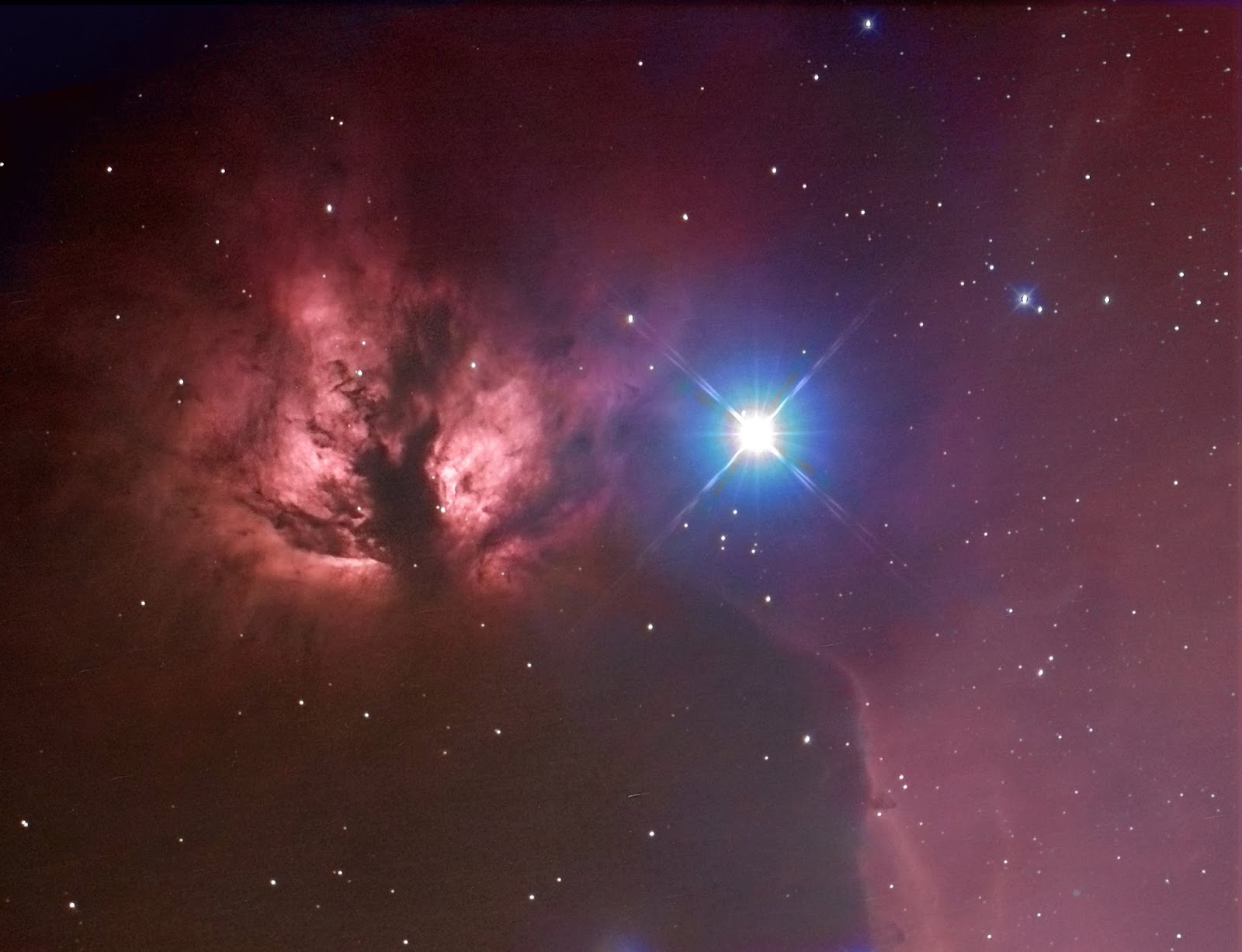
NGC2024 The Flame Nebula.
Within the constellation of Orion theHunter lies the Flame nebula next to the bright star Alnitak at a
distance of about 1,200 light years. The sky conditions on this particular evening was very poor with mist, fog and heavy light pollution to contend with. Stars was only visable down to about magnitude 3.5 so only narrow band imaging was posable. I was using my ten inch F4.8 reflector, an Atik 383L mono CCD camera and PHD auto guiding . I captured five minute sub frames with matching dark frames and combined them with flat field frames to reduce the effect of vignetting in the final image. In one of the images I used some old RGB colour data and combined it with new narrow band luminance data. The total exposure times was 60 minutes using a H Alpha filter, 30 minutes using a S11 filter and 30 minutes using an O111 filter. The colour data using the narrow band filters was H Alpha for green ,S11 for red and O111 for the blue, [ the Hubble palette ].
RGB
Narrowband
Narrowband + RGB
Sunday, 22 January 2017
NGC2174, the Monkey head nebula
NGC2174. This is commonly named the Monkey head nebula. This bright emission nebula lies in the constellation of Orion at a distance of about 6,400 light years. I took this image under heavily light polluted clear sky conditions with stars only visible down to magnitude 4. I was using my ten inch F 4.8 reflector, an Atik 383L mono ccd camera with PHD auto guiding. I captured five minute sub frames with matching dark frames and combined them with flat field frames to reduce the effect of vignetting in the final image. The hubble palette
was used for the image colour data using narrow band filters, S11 for red, HA for green and O111 for the blue. The total exposure times were 60 minutes using a S11 filter. 80 minutes using a H Alpha filter and 30 minutes using an O111 filter.
Saturday, 7 January 2017
The Soap Bubble Nebula
This cropped image is a combination of old and new data with the extra addition of two hours of H Alpha luminance. This makes a total H Alpha exposure time of three hours.
Comparison of the normal and negative image in which the soap bubble nebula is very clearly seen
The Soap Bubble nebula
Comparison of the normal and negative image in which the soap bubble nebula is very clearly seen
Saturday, 31 December 2016
IC 405
IC 405. This object is commonly named the Flaming star nebula, SH2-229. It lies in the constellation of Auriga at a distance of about 1,500 light years. I took this image on a clear moonless night under heavy light polluted sky conditions. I was using my ten inch F4.8 reflector, PHD auto guiding and an Atik 383L mono CCD camera. I captured five minute sub frames with matching dark frames and combined them with flat field frames to reduce the effect of vignetting in the
final image. Some of the colour data is a combination of narrowband data and RGB colour data using S11 for red HA for green and O111 for blue. The total exposure times was 60 minutes for H Alpha, 30 minutes for S11 and 30 minutes for O111 filter. However the total exposure times for the RGB colour data was 20 minutes for each filter.
Subscribe to:
Posts (Atom)