Monday, 28 October 2024

Images from the Exmoor National Park star party,

On October 25th and 26th, I participated in the Exmoor National Park star party, organized by the Yarn Market Hotel in Dunster, Somerset, and hosted by Terry Evans. I captured images of the Milky Way and Comet C/2023 A3, also known as Comet Tsuchinshan-Atas.

I used my Canon 10D with a Tamron 18mm-270mm zoom lens attached to my Astro Track mount. I took two-minute sub-frames along with matching dark frames, setting the camera to ISO 2300.


Thursday, 8 August 2024

The Gower night sky with as tracking mount and DSLR

The images were captured using an Astro Track mount, taking four three-minute subframes along with corresponding dark frames. These were then averaged to minimize noise in the final image. The camera used was a Canon 10D DSLR set to ISO 3200.


Tuesday, 6 August 2024

The Milky way from Oxwich Bay, Gower

I was using a Cannon 10 D DSLR on a static tripod . The exposure times were 30 seconds with matching dark frames.  I then averaged four images together to reduce the effect of noise in the final images.

Milky way images


Friday, 28 June 2024

The Milky Way

After 1:00 am, when the full cutoff LED street lights are turned off, the difference in the sky is remarkable; stars become visible overhead down to about magnitude 5.3.


The following image was captured using a Canon 10D set at ISO 3200 with an 18mm lens at f/2.8. I took twelve ten-second subframes along with matching dark frames to minimize noise in the final image.


Another image was taken from my backyard in Newport at 2:00 am after the street lights were off. The Milky Way was clearly visible with stars down to about magnitude 5.4.


For this, I used my Canon 10D DSLR camera set at ISO 3200 on a tripod, with an 18mm lens at f/2.8. I captured 16 fifteen-second subframes with matching dark frames and stacked them using Deep Sky Stacker software.

Tuesday, 18 June 2024

M11 and M27

M11, The Wild Duck Cluster: Captured using a 10-inch f/4.8 reflector, Vixen Atlux mount with PHD auto-guiding, and a Canon 50D DSLR camera. I took 30-second subframes, integrating them with corresponding dark and flat field frames to minimize noise and vignetting. The total exposure time amounted to 15 minutes.


M27, The Dumbbell Nebula: This image was obtained with a 10-inch f/4.8 reflector, Vixen Atlux mount, PHD auto-guiding, and a Canon 50D DSLR camera. The camera was set to ISO 3200, capturing 30-second subframes, which were then merged with matching dark and flat field frames to lessen vignetting effects. The cumulative exposure time was 20 minutes.


M27, The Dumbbell Nebula: The image is a composite of data from two cameras, a Canon 50D DSLR and an Atik 383L mono CCD, utilizing narrowband filters: H Alpha, OIII, and SII.


Wednesday, 29 May 2024

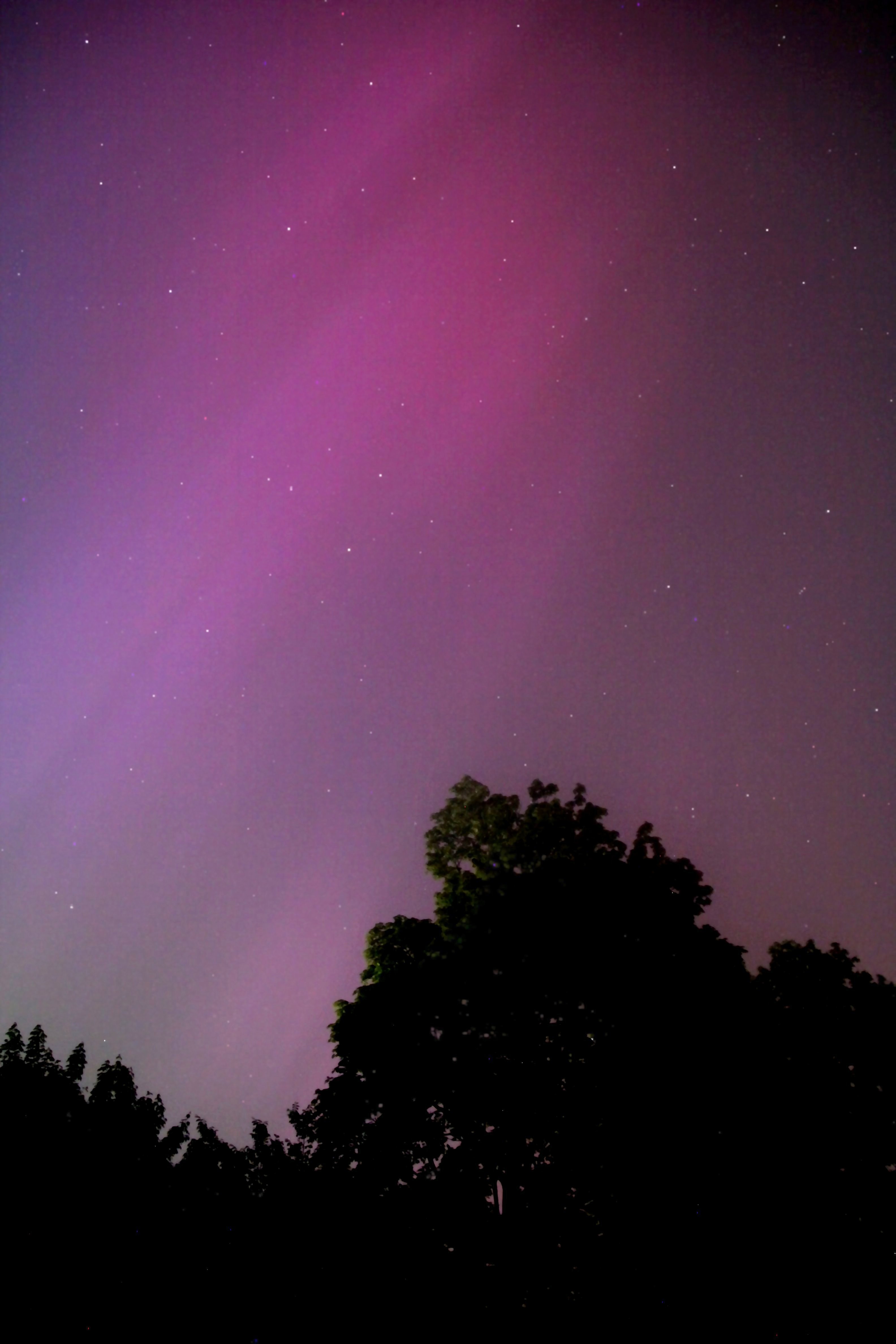
The aurora on the 10th of May 2024

Images of the aurora on the 10th of May 2024 . I have reprocessed them stacking six two and a half second exposures together using Deep Sky Stacker.


Saturday, 11 May 2024

M13

This image of M13 was taken using my Canon EOS D50 DSLR camera. I set it up at prime focus using my 10 inch f/4.8 reflector, an IDAS filter mounted on a Vixen Atlux mount. I captured 10, 15. 20 and 30 second sub frames with matching dark frames.  Total exposure time was 15 minutes. The data was then averaged and stacked using deep Sky Stacker and Paint shop Pro software.


Aurora of May 10th

I was using my Canon EOS D50 set at ISO 3200  with an 18mm lens. The exposure times are 2.5 seconds.


Sunday, 28 April 2024

Thor's Helmet

Here we have data taken using two telescopes, a 4 inch  f/6.3 refractor combined with data taken using a 10 inch f/4.8 reflector.