M65. M66 . This group of galaxies lies in the constellation of Leo at a distance of about 35 million light years . The sky conditions were exceptional ,very clear and no moonlight with only light pollution to contend with.A ten inch, F4.8 reflector was used with PHD auto guiding. The total exposure times were fourty minutes for each RGB colour filter using five minute sub frames:
NGC6946 . This face on spiral galaxy lies in the constellation of Cepheus. It lies at a distance of 22 million light. This unguided image was captured using a ten inch, f/4.8 Newtonian. The exposure times were twenty minutes for each RGB colour filter using sixty second sub frames:
Tuesday, 13 November 2012
The Whale, a Hockeystick and NGC891
NGC891. This edge on spiral galaxy lies in the constellation of Andromeda at a distance of
30 million light years. This unguided image was taken using a ten inch, F4.8 reflector. 60
second sub frames and matching dark frames were used. A total exposure time of 30 minutes
for each RGB colour channel was used.This was taken under a very clear moonless sky, with
only light pollution to contend with:
NGC4631.NGC4656/51 The Whale and Hocketstick galaxies. This pair of edge on galaxies lie
in the constellation of Canes Venatici at a distance of about thirty million light years.
This image was taken with a ten inch, f/4.8 Newtonian with PHD auto-guiding. The exposure
times were forty minutes using RGB filters with five minute sub frames and matching dark
frames. The camera was set on times 2 bin mode with the temperature set to -15 degrees
Celcius:
30 million light years. This unguided image was taken using a ten inch, F4.8 reflector. 60
second sub frames and matching dark frames were used. A total exposure time of 30 minutes
for each RGB colour channel was used.This was taken under a very clear moonless sky, with
only light pollution to contend with:
NGC4631.NGC4656/51 The Whale and Hocketstick galaxies. This pair of edge on galaxies lie
in the constellation of Canes Venatici at a distance of about thirty million light years.
This image was taken with a ten inch, f/4.8 Newtonian with PHD auto-guiding. The exposure
times were forty minutes using RGB filters with five minute sub frames and matching dark
frames. The camera was set on times 2 bin mode with the temperature set to -15 degrees
Celcius:
The Orion Nebula and NGC1805
M42. NGC1976 The Great Nebula in Orion . This image is a cropped version using a combination of exposures using RGB and narrowband filters . Unsharp masking was used to enhance the fine detail mostly with in the core region . This was done by subtracting a blurred copy of the existing image from the original image. This removes the blurred unwanted information . This technique is used by many astro-imagers . Exposure times of twenty minutes for each RGB colour filter with sub frames ranging from 60 seconds to 5 minutes because M42 has a great dynamic range. Variation in surface brightness and over exposing the CCD would saturate its core region. The exposures for the narrow band data H-alpha and Olll were 60 minutes using 60 second and 5 minute sub frames:
IC 1805 The Heart nebula . This image was taken under bright moon light with very clear sky conditions . Two narrow band filters, H-alpha and Olll were used making this image a bi-colour image . The ten inch, f/4.8 reflector was used with PHD auto guiding. The exposure times were sixty minutes for each filter using five minute sub frames:
Monday, 12 November 2012
The Cave and Pacman Nebulae
Three versions of the Pac Man nebula NGC281. There are three compositions here of RGB, bi-colour and RGB combined with bi-colour. The exposure times were 40 minutes for each RGB colour filter and 60 minutes for each narrow band filter ( H-alpha and Olll ). A ten inch, f/4.8 Newtonian with PHD auto guiding was used:
RGB
Bi-colour
RGB+Bi-colour
SH 2 - 155 The Cave nebula. This emission nebula lies in the constellation of Cepheus at a distance of 2,400 light years .This is an unguided image captured through a ten inch, f/4.8 reflector using 60s sub frames to reduce tracking errors. The exposure times were 60 minutes using a H-alpha filter and 10 minutes for each RGB colour filter:
Saturday, 10 November 2012
The Veil nebula and NGC7000
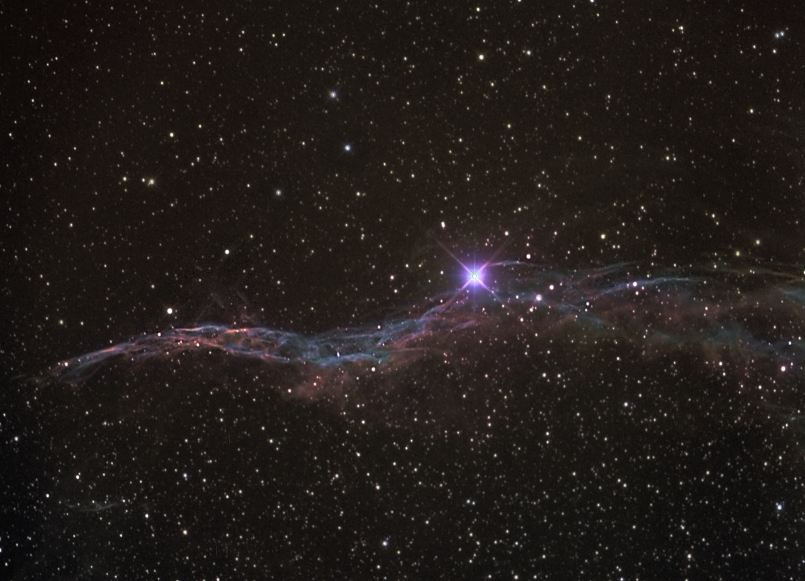
NGC6960. The Veil Nebula. This supernova remnant subtends three degrees, that is six moon diameters. It surrounds the star Cygi 52 in the constellation of Cygnus, at a distance of about 1,400 light years. Five minute sub frames and matching dark frames were captured with the camera temperature set at -15 degrees. A ten inch, f/4.8 Newtonian was used with PHD auto guiding.The total exposure time was ninety minutes using an Olll filter, sixty minutes with a H-alpha filter and thirty minutes through each RGB colour filter:
Looking furthet to the east we have NGC6992, the eastern section of the Veil Nebula. This image contains narriow band data only with exposure times of sixty minutes for the Olll and H-alpha filters using five minute sub frames:
NGC7000 . The North America Nebula . This emission nebula lies at a distance of about 1,800 light years and subtends an angle of six degees. Sixty second sub frames were stacked with matching dark frames. A total exposure time of 60 minutes was made in in H-alpha and 20 minutes for each RGB colour filter:
Looking furthet to the east we have NGC6992, the eastern section of the Veil Nebula. This image contains narriow band data only with exposure times of sixty minutes for the Olll and H-alpha filters using five minute sub frames:
NGC7000 . The North America Nebula . This emission nebula lies at a distance of about 1,800 light years and subtends an angle of six degees. Sixty second sub frames were stacked with matching dark frames. A total exposure time of 60 minutes was made in in H-alpha and 20 minutes for each RGB colour filter:
Friday, 9 November 2012
M15 and M97
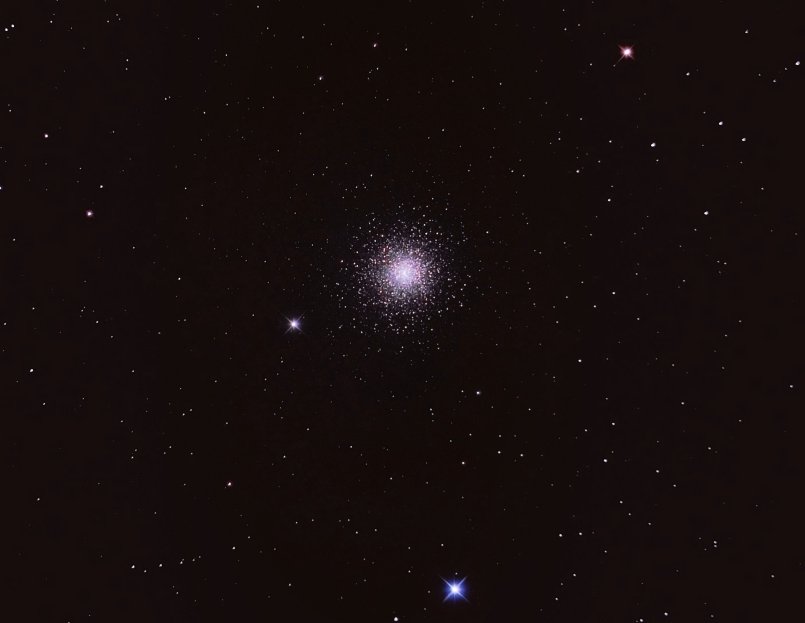
This image of M15 was taken unguided, using 60 second sub frames thus reducing the
effects of periodic tracking errors. The total exposure time was ten minutes for each
colour filter:
M97, NGC3587. The Owl nebula. This planetary nebula lies at a distance of 2600 light years
in the constellation of Ursa Major. PHD guiding was used with a 10 inch, f/4.8 reflector.
Sub frames five minutes long were captured. The exposure time for H-alpha was sixty
minutes, and the exposure time for Olll was ninety minutes. These data were then combined
with the colour data using RGB filters with exposure times of twenty minutes for each
filter:
effects of periodic tracking errors. The total exposure time was ten minutes for each
colour filter:
M97, NGC3587. The Owl nebula. This planetary nebula lies at a distance of 2600 light years
in the constellation of Ursa Major. PHD guiding was used with a 10 inch, f/4.8 reflector.
Sub frames five minutes long were captured. The exposure time for H-alpha was sixty
minutes, and the exposure time for Olll was ninety minutes. These data were then combined
with the colour data using RGB filters with exposure times of twenty minutes for each
filter:
Thursday, 8 November 2012
M31 and M95 with a supernova
M31. The Andromeda galaxy . This galaxy lies at a distance of 2.3 million light years and subtends an angle of about 3 degrees in the night sky, about six moon diameters. This image was unguided so the sub frames were 60s to reduce tracking errors. The total exposure time for each RGB colour filter was 15 minutes:
M95. NGC3351.This barred spiral galaxy lies in the constellation of Leo at a distance of about 38 million light years. Thirty minute exposure times for each RGB filter using five minute subframes . A 10 inch, f/4.8 reflector with PHD auto guiding software.
The arrow indicates the 16th of March 2012 supernova:
M95. NGC3351.This barred spiral galaxy lies in the constellation of Leo at a distance of about 38 million light years. Thirty minute exposure times for each RGB filter using five minute subframes . A 10 inch, f/4.8 reflector with PHD auto guiding software.
The arrow indicates the 16th of March 2012 supernova:
Wednesday, 7 November 2012
M101 and NGC2903
M101, NGC5457. The Pinwheel galaxy. This galaxy is a face on spiral galaxy lying at a
distance of about twenty million light years in the constellation of Ursa Major. PHD auto
guiding software was used. A composition of five minute sub frames stacked with matching
dark frames to make a total exposure time of thirty minutes for each RGB colour filter:
NGC2903 . This barred spiral galaxy lies in the constellation of Leo at a distance of
about 30 million light years. Without autoguiding, 60 second sub frames were captured
making a total exposure times of twenty minutes for each colour filter. The sky conditions
were very clear on this particular evening with bright gibbous moonlight:
distance of about twenty million light years in the constellation of Ursa Major. PHD auto
guiding software was used. A composition of five minute sub frames stacked with matching
dark frames to make a total exposure time of thirty minutes for each RGB colour filter:
NGC2903 . This barred spiral galaxy lies in the constellation of Leo at a distance of
about 30 million light years. Without autoguiding, 60 second sub frames were captured
making a total exposure times of twenty minutes for each colour filter. The sky conditions
were very clear on this particular evening with bright gibbous moonlight:
NGC7814 and NGC5985
NGC7814. This spiral galaxy looks similar to the Sombrero galaxy and lies deep in the
constellation of Pegasus at a distance of about 40 million light years. A 10", f/4.8 Newtonian was used. Sub frames of 60 seconds were used without autoguiding . The total exposure time for each colour filter was forty minutes with matching dark frames:
NGC5985 . This group of galaxies is in the constellation of Draco . Without using an
auto guider, one minute sub frames were captured and stacked with matching dark frames . The total exposure time for each colour channel was thirty minutes:
constellation of Pegasus at a distance of about 40 million light years. A 10", f/4.8 Newtonian was used. Sub frames of 60 seconds were used without autoguiding . The total exposure time for each colour filter was forty minutes with matching dark frames:
NGC5985 . This group of galaxies is in the constellation of Draco . Without using an
auto guider, one minute sub frames were captured and stacked with matching dark frames . The total exposure time for each colour channel was thirty minutes:
Tuesday, 6 November 2012
The Virgo Cluster
This image of the Virgo cluster was taken through a ten inch, f/4.8 reflector using exposure
times of 90 minutes through a blue filter , 1 hour through a red filter and 40 minutes
through a green filter . Ten minute sub frames were used with matching dark frames:
times of 90 minutes through a blue filter , 1 hour through a red filter and 40 minutes
through a green filter . Ten minute sub frames were used with matching dark frames:
Subscribe to:
Posts (Atom)