Thursday, 29 November 2012

NGC6914 and the Butterfly Nebula

NGC6914. This diffused reflection nabula is a very colourful region of the milky way lying
at a distance of about 6,000 light years in the constellation of Cygnus.This PHD guided
exposure was taken using ten minute sub frames with matching dark frames.The total
exposure times was twenty minutes for each colour channel and one hour using a Lumicon H-
alpha filter. Taken using a four inch f/7 refractor with a field flattener making it
f/6.3. The camera was an Atik 383L:


IC 1318, The Butterfly nebula. The nebula lies in the constellation of Cygnus near the
bright star Gamma Cygni. Five minute sub frames were captured with matching dark frames of
the luminance channel, H-alpha with a total exposure time of twenty minutes. The colour
channels had exposure times sixty seconds. The image was taken using a ten inch reflector
with PHD guiding:


Tuesday, 27 November 2012

The Cocoon nebula and the Andromeda galaxy

NGC5146, The Cocoon Nebula. This unguided image was taken using a ten inch, f/4.8 reflector with an Atik 314L CCD camera. Sixty second sub-frames were captured and with matching dark frames. The total exposure times were ten minutes for each colour channel and 120 minutes for the luminance channel, H-alpha:


This unguided image of M31 reveals the dust lines of our nearest neighbouring galaxy, the Andromeda galaxy. Sixty second sub frames was captured with matching dark frames. The total exposure time was 15 minutes for each colour channel using a  ten inch, f/4.8 reflector and an Atik 314L CCD camera:

Monday, 26 November 2012

M1 and NGC7000

This unguided image of the Crab Nebula M1, was taken using an Atik 314L CCD camera, a ten
inch f/4.8 reflector. The total exposure times were twenty minutes for each colour filter
and thirty minutes using a H-alpha filter. One minute sub-frames were captured with
matching dark frames:


This image is a small section of NGC7000, A section of the south westen limb commonly named the wall of the North America Nebula in Cygnus the Swan. This unguided image was made by capturing sixty second sub-frames and matching dark frames. The total exposure times were 15 minutes for each colour filter and 40 minutes using an H-alpha filter:


Sunday, 25 November 2012

The Crescent and Veil nebulae

NGC6888, The Crescent nebula. This image was taken using exposure times of 15 minutes for
each colour filter and one hour using a H-alpha luminance filter. Unguided, 60 seconds
sub-frames with matching dark frames were captured. A ten inch f/4.8 reflector and an Atik
314L CCD camera were used:


This unguided image of the Veil nebula NGC6960 was taken using an Atik 314L CCD camera
using a ten inch reflector. 60 second subframes were captured with matching dark frames.
The total exposure times were five minutes for each colour filter and 120 minutes for the
luminance H-alpha channel:


Saturday, 24 November 2012

NGC7635 and NGC891

NGC7635, The Bubble nebula. This emission nebula lies in the constellation of Cassiopeia at a distance of about 11,000 light years. This unguided image was taken using one minute sub frames stacked with dark frames. An Atik 314L CCD camera was used with a ten inch, f/4.8 reflector. The exposure times for the colour channels was two minutes through each RGB filter. However the luminance channel in H-alpha had a total exposure time of two hours


NGC891. This edge on spiral galaxy lies in the constellation of Andromeda, shining at magnitude 10.8, at a distance of 27 - 30 million light years. Four, five minute sub-frames were captured for each colour channel, with matching dark frames. A ten inch, f/4.8 reflector was used with PHD auto guiding and an Atik 383L CCD camera.


Friday, 23 November 2012

The Crab Nebula and M42

M1 The Crab nebula, NGC1952 lies in the constellation of Taurus. It is a supernova remnant
at a distance of about 6,500 light years. The total exposure times was twenty minutes for
each colour channel capturing five minute sub-frames with matching dark-frames . An Atik
383L CCD camera and a ten inch, f/4.8 reflector were used with PHD auto guiding:


M42. The RGB exposure times were twenty five minutes for each colour channel using sets
of five one minute sub-frames combined with four, five minute sub-frames and matching
dark-frames. The luminance channels, H-alpha and Olll were taken capturing five minutes
sub-frames. The total exposure time was ninety minutes using an Olll filter and 120
minutes using a H-alpha filter. This image was captured using a ten inch, f/4.8 reflector
with PHD auto guiding and an Atik 383L CCD camera:

RGB
 
 
Narrowband

 
RGB & Narrowband Combined

Wednesday, 21 November 2012

Comet Lulin and M87

Comet Lulin . Comets move against the starry sky This causes complications with image calibration. This image contains three exposures using red, green and blue filters . The exposures were sixty seconds long. This unguided image was taken with an Atik 314L CCD camera and a ten inch f/4.8 reflector:


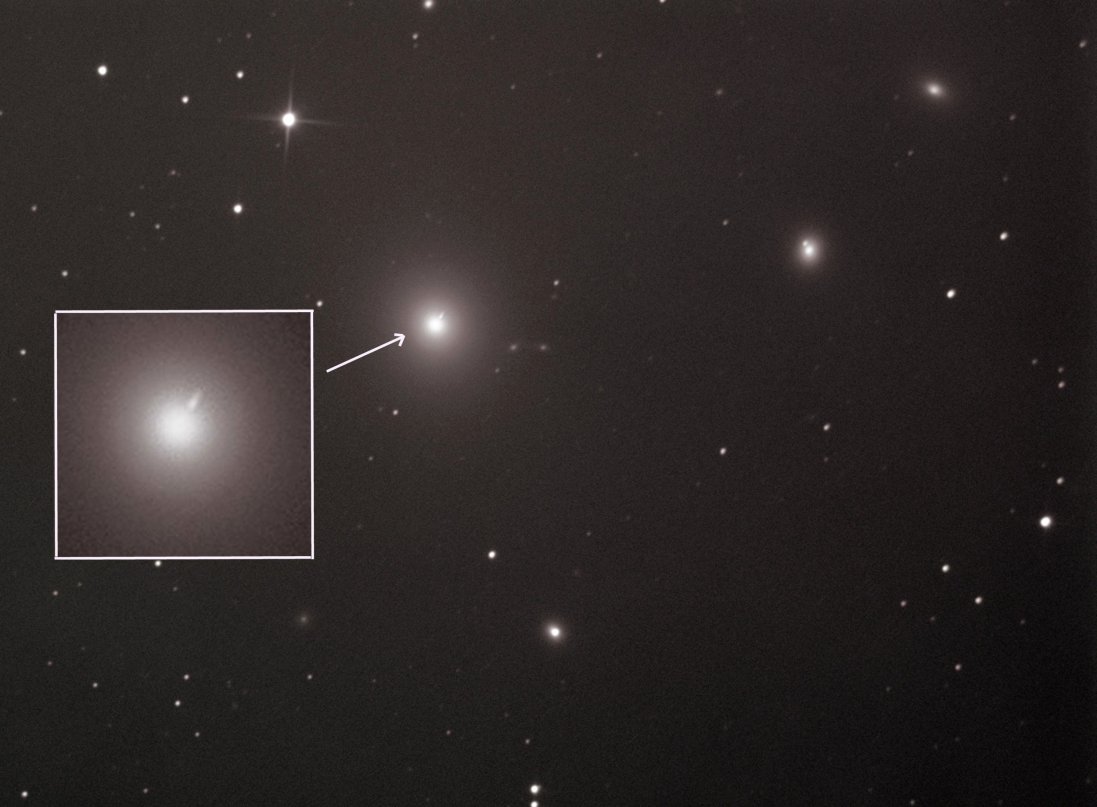
M87. This giant elliptical galaxy lies at a distance of about 50 million light years in the constellation of Virgo and exhibits a jet.  The jet consists of materiel ejected from the galaxys core that is believed to contain a super massive black hole. This unguided image was taken under bright moon light with clear sky conditions.  A ten inch f/4.8 reflector, an Atik 314L CCD camera. The total exposure time was 15 minutes for each colour channel using 60 second sub-frames:

Tuesday, 20 November 2012

The Swan and Hubble's variable nebulae

M17, The Omege or Swan nebula. This bright emission nebula lies in the constellation of
Sagittarius at a distance of about 5,000 light years. This object is about 15 light years
in diameter. This unguided image was taken using an Atik 314 L CCD camera, a ten inch
f/4.8reflector. Sixty second sub-frames was captured with matching dark-frames . Total
exposures times of five minutes for each colour filter were used and thirty minutes for
the luminance channel in H-alpha:


NGC2261, Hubbles variable nebula. This reflection nebula lies deep in the constellation
Monoceros the Unicorn at a distance of about 2,500 light years. This unguided image was
taken using an Atik 314L CCD camera, a ten inch, f/4.8 reflector. 60 second sub frames
were captured making total exposure times of twenty minutes for each colour channnel:


Monday, 19 November 2012

M97 and M42

M97. The Owl nebula lies in the constellation of Ursa Major at a distance of about 2,600
light years. Notice the surrounding galaxies, This demonstrates the sensitivity of CCD
imaging. Taken unguided, through a ten inch f/4.8 refector. An Atik 314L CCD camera was
used under very clear moonless sky conditions . Sixty second sub-frames and matching
dark-frames were used, making total exposure time of sixty minutes for each colour filter:


This image of M42 was taken using only RGB data. An Atik 314L CCD camera was used with a ten inch f/4.8 reflector, unguided.   Sixty second sub-frames and matching dark-frames were used. The exposure time was thirty minutes for each colour channel, giving a total exposure time of ninety minutes:


NGC6826 and NGC2392

NGC6826, The Blinking planetary nebula. This object lies in the constellation of Cygnus at a distance of about 2,000 light years. This unguided image was captured using a ten inch f/4.8 reflector and an Atik 314L CCD camera.  60 second sub frames were captured making a total exposure time of 15 minutes for each colour channel:


NGC2392. The Eskimo or Clownface nebula. This bright planetary nebula lies at a distance of about 2,800 light years in the constellation of Gemini. This image was captured using a 2x Barlow lens with a ten inch f/4.8 reflector. The camera was an Atik 314L CCD camera. Ten seconds sub-frames were used making a total of 15 minutes for each colour channel: