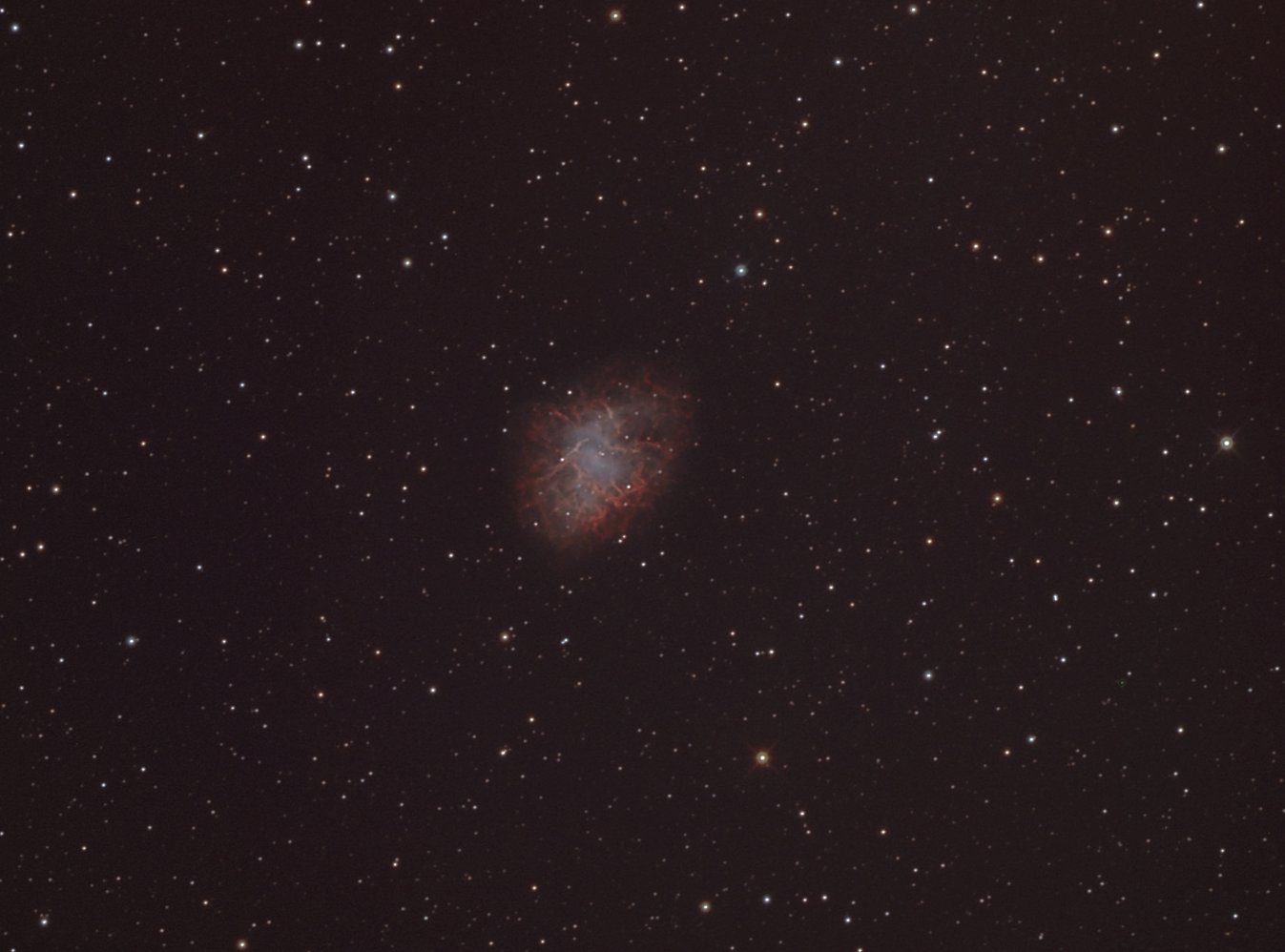
This image of the cone nebula contains old data with added H-alpha luminance data. The total exposure time of the added data was sixty minutes.
Saturday, 24 February 2018
Saturday, 17 February 2018
NGC2264, the Fox Fur nebula
Here we have a cropped composition of NGC2264, the Fox Fur nebula with added H-alpha luminance. A total exposue time of four hours.
Saturday, 3 February 2018
NGC3580.
NGC3580. I took this image using Astronomik narrowband filters SII, OIII and H-alpha and I used the Hubble Palette for the colour data. The setup I was using was my ten inch f/4.8 reflector, a Vixen Atlux mount, PHD auto guiding and an Atik 383L mono CCD camera. I captured five minute sub frames with matching dark frames and combined them with flat field frames to reduce the effect of vignetting in the final image. The total exposure times were 40 minutes for each filter.
Final image cropped
Thursday, 1 February 2018
B33 The Horsehead nebula
Filter Test. Here we have B33 the Horsehead nebula, imaged 30 degrees away from the full moon under clear sky conditions. The total exposure time was 2 hours and twenty minutes. I captured five minute sub
frames with matching dark frames and combined them with flat field frames to reduce the effect of vignetting in the final image. The filter was an Astronomik H-alpha filter.
This is a combination of old and new data. The total exposure time was 5 hours.
Tuesday, 23 January 2018
NGC2264 The Cone nebula.
NGC2264 The Cone nebula. This is the southern region of the same cloud that contains the Fox Fur nebula, lying at a distance of about 2,700 light years in the consellation of Monoceros. I was using my ten inch, f/4.8 reflector, a Vixen Atlux mount, PHD auto guiding, an Atik 383L mono CCD camera and a set of Astronomik narrowband filters, SII, OIII and H-alpha. I captured five minute sub frames with matching dark frames and combined them with flat field frames to reduce the effect of vignetting in the final image. The total exposure times for each filter was sixty minutes.
Hubble Palette + RGB data
Narrowband Hubble Palette
Narrowband luminance + RGB colour
Fox fur and the cone nebulae
Monday, 22 January 2018
NGC2264 The Fox Fur Nebula.
NGC2264 The Fox Fur Nebula. This cloud of nebulosity belongs to the same cloud that contains the cone nebula and the Chrismas tree cluster. It lies in the consellation of Monocceros the Unicorn at a distance of 2,700 light years. I was using my Ten inch F4.8 reflector, a Vixen Atlux Mount PHD auto guiding an Atik 383L mono CCD camera and a set of Astronomik narrowband filters. The filters I was using were SII, OIII, H-alpha and blue. I captured five minute sub frames with matching dark frames and combined them with flat field frames to reduce the effect of vignetting in the final image. The sky conditions on this particular evening were very good. Stars were visible down to magnitude five. The total exposure times were 90 minutes using a H-alpha filter, sixty minutes using an OIII filter, forty minutes using an SII filter and thirty minutes using a blue filter.
Narrowband + RGB
Narrowband luminance, RGB colour data
Hubble Palette
Foxfur Cropped
Sunday, 21 January 2018
NGC2244 The Rosette nebula.
NGC2244 The Rosette nebula. This hydrogen emission nebula is a star forming complex that lies in the constellation of Monoceros, 5,200 light years away from us. It covers an area of sky 1.3 degrees with a radius of about 65 light years. I was using my ten inch F4.8 reflector, a Vixen Atlux mount, PHD auto guiding and an Atik 383L mono CCD camera. The total exposure time was sixty minutes for each filter, capturing five minute sub frames with matching dark frames. The data were then combined with flat field frames to reduce the effect of vignetting in the final image. The filters I was using was a set of Astronomik narrowband filters, SII, OIII and H-alpha, using the Hubble palette for the colour data.
NGC 2244. This section of the Rosette nebula was taken under intermittent sky conditions, the sky was changing with clouds, so I was limited with the amount of imaging time. I used the camera on times-two bin mode, increasing the camera's sensitivity by four times. I captured five minute sub frames with dark frame and flat frames, managing to get a total exposure time of 15 minute for each filter.
Wednesday, 17 January 2018
B33. The Horeshead nebula.
B33. The Horeshead nebula. This image was taken under clear light-polluted sky conditions with stars visable down to magnitude 5. I was using my ten inch f/4.8 reflector, a Vixen Atlux mount, P.H.D. auto-guiding , an Atik 383L mono CCD camera and a set of Astronomic narrowband filters.
I captured five minute sub frames with matching dark frames and combined them with flat field frames to reduce the effect of vignetting in the final image. The filters I was using were SII, OIII and H-alpha, with a total exposure time of 50 minutes for each filter.
Horsehead and Flame nebula in narrowband
Horsehead and Flame nebula, narrowband luminance + RGB
B33 narrowband
Tuesday, 16 January 2018
M1 The Crab nebula
M1 The Crab nebula. This supernova remnant lies in the constellation of Taurus the Bull at a distance of about 6,000 light years. Lying in its centre is the Crab pulsar rotating at a speed of 30 times per second. I took this image under foggy conditions with cloud cover closing in giving me only about 40 minutes of imaging time. I used my set of Astronomik narrowband filters SII, H-alpha and OIII and was only able to get total exposure times of ten minutes for the SII and OIII channels plus a total exposure time of 20 minutes for the H-alpha channel. I then combined the data with some old R.G.B. data resulting a smoother image reducing the amount of noise in the image.
I captured five minute sub frames with matching dark frames and combined them with flat field frames to reduce the effect of vignetting in the final image. The telescope I was using was my ten
inch f/4.8 reflector with a Vixen Atlux mount, PHD auto guiding and an Atik 383L mono CCD camera.
I captured five minute sub frames with matching dark frames and combined them with flat field frames to reduce the effect of vignetting in the final image. The telescope I was using was my ten
inch f/4.8 reflector with a Vixen Atlux mount, PHD auto guiding and an Atik 383L mono CCD camera.
Narrowband Hubble Palette
RGB
Narrowband Huble Palette plus RGB
Monday, 15 January 2018
IC5070 The Pelican nebula and IC1396 The Elephant trunk nebula.
IC5070 The Pelican nebula. This nebula lies in the constellation of Cygnus the Swan at a distance of about 1,800 light years, near NGC 7,000 The North America nebula. The sky conditions on this particular evening were very poor, it was hazy with a full moon, stars were only visible down to about magnitude 3.5. However narrowband CCD imaging was still possable. I was using my ten inch f/4.8 reflector with a Vixen Atlux mount, PHD auto guiding and an Atik 383L mono CCD camera.
I captured five minute sub frames with matching dark frames and combinded them with flat field frames to reduce the effect of vignetting in the final image. I used a set of Astronomik narrowband filters and used the Hubble palette for the colour data using SII for the red , H-alpha for the green and OIII for the blue channel . The total exposure times were 40 minutes for each filter.
IC1396 The Elephant trunk nebula. This dark nebula lies in the constellation of Cepheus the king at a distance of about 2,400 light years. I took this image under very clear, light polluted sky conditions with stars visable down to magnitude 5. I was using my ten inch f/4.8 reflector, a Vixen Atlux mount, PHD auto guiding and an Atik 383L mono CCD camera.
I captured five minute sub frames with matching dark frames and combinded them with flat field frames to reduce the effect of vignetting in the final image. The Hubble palette was used for the colour data using a set of Astronomik narrowband filters, SII , H-alpha and OIII filters. SII for the red channel, H-alpha for the green channel and OIII for the blue channel. The total exposure times for each filter was sixty minutes.
I captured five minute sub frames with matching dark frames and combinded them with flat field frames to reduce the effect of vignetting in the final image. I used a set of Astronomik narrowband filters and used the Hubble palette for the colour data using SII for the red , H-alpha for the green and OIII for the blue channel . The total exposure times were 40 minutes for each filter.
IC1396 The Elephant trunk nebula. This dark nebula lies in the constellation of Cepheus the king at a distance of about 2,400 light years. I took this image under very clear, light polluted sky conditions with stars visable down to magnitude 5. I was using my ten inch f/4.8 reflector, a Vixen Atlux mount, PHD auto guiding and an Atik 383L mono CCD camera.
I captured five minute sub frames with matching dark frames and combinded them with flat field frames to reduce the effect of vignetting in the final image. The Hubble palette was used for the colour data using a set of Astronomik narrowband filters, SII , H-alpha and OIII filters. SII for the red channel, H-alpha for the green channel and OIII for the blue channel. The total exposure times for each filter was sixty minutes.
Subscribe to:
Posts (Atom)