Saturday, 21 January 2023

NGC2264, The Christmas tree cluster, The Foxfur and Cone nebula.

NGC2264, The Christmas tree cluster, The Foxfur and Cone nebula. This patch of nebulosity lies in the constellation of Monoceros. I took this image on five separate evenings using Astronomik narrowband and RGB filters. The H Alpha data were taken under bright moon light with the O111 and S11 data whereas the RGB data were taken under clear moonless sky conditions. I was using my 4 inch f/6.3 refractor, a Vixen Atlux mount, PHD auto guiding and an Atik 383L mono CCD camera, I captured five minute sub frames with matching dark frames and combined them with flat field and bias frames to reduce the effect of noise and vignetting in the final image, The total exposure times were seven and a half hours using a H Alpha filter, two hours using an O111 filter, 3 hours using a S11 filter, and 1 hour using each RGB filter. A total exposure time of 15 and a half hours.

RGB Colour


Hubble Palette


Data of NGC2264 combined using two telescopes, a 4 inch refractor and a ten inch reflector.


Friday, 20 January 2023

IC5146 The Cocoon nebula

IC5146 The Cocoon nebula. This image was taken on two separate nights under bright moonlight with stars only visible down to magnitude 4, I was using my 4 inch f/6,3 refractor, a Vixen Atlux mount , PHD auto guiding ,  Astronomik filters  HA , O111 and blue, and an Atik 383L mono CCD camera. I captured five minute sub frames with matching dark frames and combined them with flat field frames and bias frames to reduce the effect of vignetting in the final image, The total exposure times on each evening were 60 minutes using a HA filter, 20 minutes using an O111 filter and 15 minutes using a blue filter.


Wednesday, 21 December 2022

Old and new data of M42 from two scopes.

Old and new data of M42 from two telescopes A 4 inch refractor and a ten inch reflector, A total of about 30 hours of data.

The Orion nebula


Monday, 19 December 2022

M42 and its surrounding nebulosity

M42 and its surrounding nebulosity. This image of the Orion nebula was taken on four separate nights with very clear sky conditions. On the first two evenings the sky was very bright with the moon being almost full so I used my Astronomik H-alpha filter. On the third evening I used an O111 filter and on the fourth evening I used an S11 filter with RGB filters. I captured 60 second and five minute sub frames with matching dark frames and combined them with bias frames and flat field frames reducing the effect of nose and vignetting in the final image. The telescope was a 4 inch f/6.3 refractor with a Vixen Atlux mount, PHD auto guiding , a set of Astronomik narrowband and RGB filters. and an Atik 383L mono CCD camera. The total exposure times were ten minutes for each RGB filter, six hours and ten minutes using a H Alpha filter, two hours and 45 minutes using an O111 filter and two hours and ten minutes using an S11 filter giving  a total exposure time of 11 hours and 35 minutes. Notice the faint surrounding nebulosity in the background

Click on an image to get a closer view

Hubble Palette


Hubble Palette with enhanced background


OIII, SII, H-alpha luminance RGB colour


Hubble Palette RGB colour

The Pelican nebula and the North America nebula

IC5070, IC5067. the Pelican nebula . This patch of nebulosity lies just west of the North American nebula in the constellation of Cygnus the Swan. I took this image under very clear sky conditions with full moon light to contend with. Stars was only visible down to magnitude 4. The telescope I was using was a 4 inch f/6.3 refractor with a Vixen Atlux mount, PHD auto guiding, a set of Astronomik narrowband filters and an Atik 383L mono CCD camera. I captured five minute sub-frames with matching dark frames and combined them with bias frames to reduce readout nose and flat field frames to reduce the effect of vignetting in the final image. The total exposure times were 60 minutes using a H Alpha filter, 35 minutes using an O111 filter, then the clouds rolled in and I only managed to capture 15 minutes using a S11 filter.


NGC700 was similarly imaged

The two images were combined into a mosaic


Thursday, 8 December 2022

B33 and NGC7000

NGC7000. The North America nebula.  This large patch of nebulosity lies about one degree east of the bright star Deneb in the constellation of Cygnus the swan. On this particular evening the moon was full and stars were only visable down to magnitude 3. I was using my 4 inch f/6.3 refractor, a Vixen Atlux mount, PHD auto guiding, an Atik 383L mono CCD camera and a set of Astronomik narrowband filters, S11, O111 and H-alpha. I captured five minute subframes with matching dark frames and combined them with flat field frames and bias frames reducing the effect of noise and vignetting in the final image. The total exposure times were 60 minutes using an O111 filter, 60 minutes using a H-alpha filter, 50 minutes using a S11 filter and five minutes using a blue filter.

Hubble Palette


RGB


B33 data from two telescopes: a 4 inch F/6.3 refractor and a ten inch F/4.8 reflector.


Wednesday, 30 November 2022

More data on NGC2024 and B33. The Horsehead and Flame nebulae.

NGC2024 and B33. The Horsehead and Flame nebulae. I took this image on four separate evenings  under very clear sky conditions stars were visible down to magnitude 5.2.  The total exposure times were 30 minutes using a blue filter, 45 minutes using an S11 filter, 65 minutes using an O111 filter and six hours using a H Alpha filter. I captured five minute sub frames with matching dark frames and combined them with flat field frames to reduce the effect of vignetting in the final image. The telescope I was using was a 4 inch f/6.3 refractor, with  a Vixen Atlux mount, PHD auto guiding, A set of Astronomik narrowband, RGB filters and an Atik 383L mono CCD camera.

Hubble palette


Hubble palette + RGB colour


RGB colour, narrowband luminance


Final composition


Wednesday, 23 November 2022

The Horsehead and Flame nebulae

B33 and NGC2024. The Horsehead and Flame nebulae. The sky was very clear on this evening, stars were visible down to magnitude five with only light pollution to contend with. I was using a 4 inch f/6.3 refractor, a Vixen Atlux mount PHD auto guiding, Astronomik filters H Alpha for image luminance combined  with RGB for colour data and an Atik 383L mono CCD camera. I captured five minute sub frames with matching dark frames and combined them with flat field frames to reduce the effect of vignetting in the final image. The total exposure times were 120 minutes using a H Alpha filter and ten minutes for each RGB filter. 

RGB

RGB stars eroded


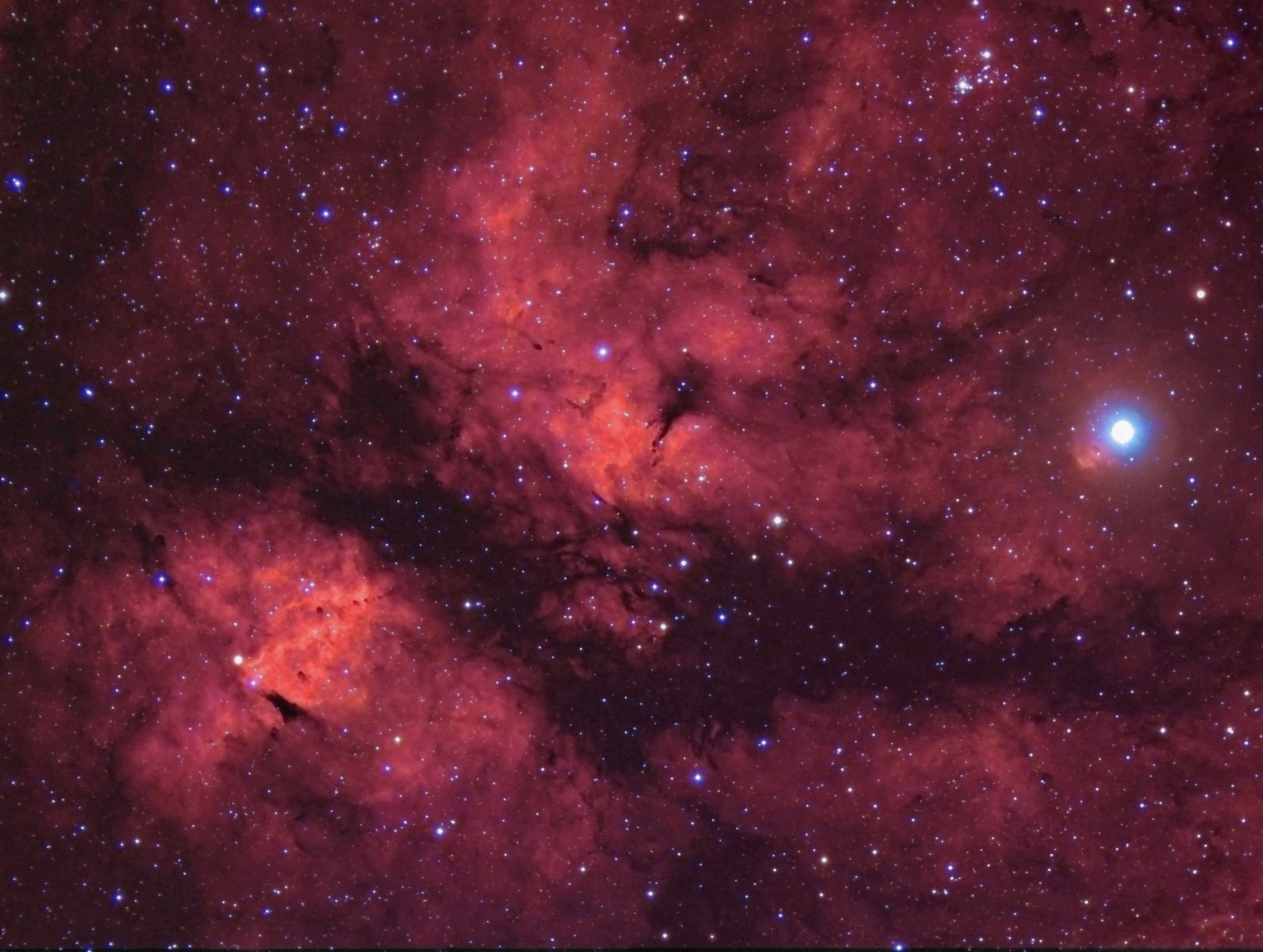
IC1318 The Butterfly nebula

IC1318 The Butterfly nebula . The patch of nebulosity lies in the constellation of Cygnus the Swan . The bright star in this image is Gamma Cygni . The sky was particularly clear on this evening with stars visible down to magnitude five. I was using a 4 inch F 6/3 refractor , a Vixen Atlux mount,, PHD auto guiding , an Atik 383L mono CCD camera a set of Astronomik narrowband filters S11, HA , O111 and RGB filters. I captured five minute sub frames with matching dark frames and combined them with flat field frames to reduce the effect of vignetting in the final image. The total exposure times was 60 minutes using a H Alpha filter 20 minutes using an S11 filter and 20 minutes using an O111 filter. 

Hubble Palette


RGB


Monday, 21 November 2022

Final result of NGC6888 and the Soap Bubble nebula

Here we have the final result of NGC6888 and the Soap Bubble nebula. An extra four hours of H Alpha luminance has been added giving a total exposure time of twelve and a half hours.