This 7 section mosaic of IC1396, commonly named the Elephant Trunk nebula lies in the star constellation of Cepheus the King. I collected the data on six separate evenings under clear sky conditions with only light pollution to contend with. The telescope was a 4 inch F/6.3 refractor, a Vixen Atlux mount, an Atik 383L mono CCD camera and a set of Astronomik narrowband filters. I captured 60 second sub frames with matching dark frames and combined them with flat field frames to reduce the effect of noise and vignetting in the final image. The total exposure times for each section with the camera set on X2 bin mode were 60 minutes using a H Alpha filter, 20 minutes using an O111 filter, 20 minutes using an S11 filter, 15 minutes using a H Beta filter and 15 minutes using a blue filter.
Monday, 18 September 2023
Saturday, 26 August 2023
IC1396, The Elephant trunk nebula.
IC1396, The Elephant trunk nebula. This patch of nebulosity lies in the constellation of Cepheus the king. I took these images on two separate evenings under clear moonless sky conditions with stars visible down to magnitude 5. On this occasion I was not using auto guiding and only using 60 second sub frames with the camera set on x 2 bin mode. I then combined the data with matching dark frames and flat field frames to reduce the effect of noise and vignetting in the final images making the two sections mosaic. The telescope I was using was an f/6.3, 4 inch refractor, a Vixen Atlux mount, a set of Astronomik narrowband filters and an Atik 383L mono CCD camera. The exposure times were 60 minutes using a H A filter, 20 minutes using an O111 filter, 20 minutes using an S11 filter, 15 minutes using a H beta filter and 15 minutes using a blue filter.
Thursday, 10 August 2023
SH2-101, The Tulip nebula and M56, globular star cluster.
SH2-101, The Tulip nebula. Ths nebula lies in the constellation of Cygnus the Swan in a region named Fish on the platter. I was using my four inch F/6.3 refractor, a Vixen Atlux mount, PHD auto guiding, a set of Astronomik narrowband filters and an Atik 383L mono CCD camera. I captured five minute sub frames with matching dark frames and combined them with flat field frames to reduce the effect of vignetting in the final image. The total exposure time was 65 minutes using a H Alpha filter, ten minutes using a blue filter, 20 minutes using an s11 filter. The O111 filter was taken using 60 second subframes with matching dark frames with a total exposure time of 45 minutes. The arrow indicates what I believe to be the location of Cygnus X-1
Click on an image to get a closer view
The Tulip nebula
M56. This globular star cluster lies in the constrellation of Lyra the Harp. This image was taken using a 4inch F/6.3 refractor, a vixen Atlux mount, PHD auto guiding, a set of Astronomik narrowband filters and an Atik 383L mono CCD camera. I captured five minute sub frames with matching dark frames and combined them with flat field frames to reduce the effect of vignetting in the final image. The exposure time was ten minutes using a blue filter, ten minutes using an O111 filter and 50 minutes using a H Alpha filter.
M56
Tuesday, 13 June 2023
M16, The Eagle nebula.
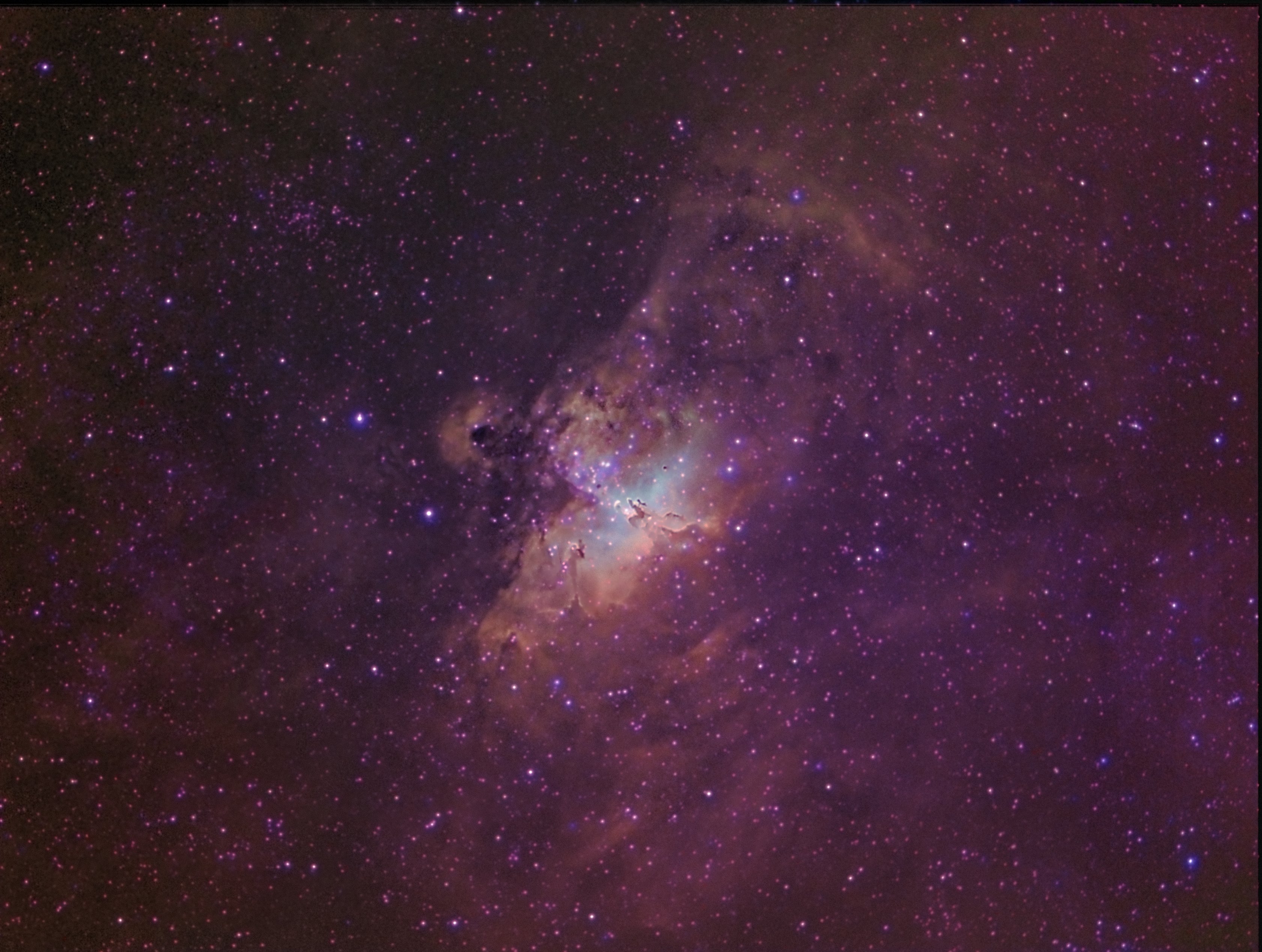
M16, The Eagle nebula. This image was taken on two separate evenings, 90 minutes using a H Alpha filter . ten minutes using an O111 filter, 15 minutes using an S11 filter and 15 minutes using a H Beta filter. I was using my 4 inch F/6.3 refractor, a Vixen Atlux mount PHD auto guiding, a set of Astronomik narrowband filters and a Atik 383L mono CCD camera. I captured five minute sub frames with matching dark frames and combined them with flat field and bias frames to reduce the effect of noise and vignetting in the final image.
Click on the image to get a closer view
The Eagle nebula
RGB plus Hubble Palette
Saturday, 29 April 2023
IC443, The Jellyfish nebula
This image was taken using my 4 inch f/6.3 refractor, a Vixen Atlux mount, PHD auto-guiding, a set of Astronomiik narrowband filters, S11, O111 and H Alpha, with an Atik 383L mono CCD camera. I captured five minute sub frames with matching dark frames and combined them with bias and flat field frames to reduce the effect of vignetting in the final image. The H Alpha luminance data was taken on two separate evenings, combined with some old narrowband colour data. The total exposure time was 60 minutes using O111 and S11 filters and 120 minutes using a H Alpha filter.
RGB image
Hubble Palette + RGB
Thursday, 13 April 2023
More renderings of the Rosette nebula
Here are another two versions of the Rosette nebula image using H-Beta and O111 as the blue channel combined with H-Alpha as the red channel. The image is Bi colour whereas the second image is Bi colour combined with the Hubble palette
Bi Colour
Bi colour combined with the Hubble palette
Wednesday, 12 April 2023
The Rosette nebula
NGC2244.Two of these three images of the Rosette Nebula reveal extra data taken using an Astronomik H Beta filter. I was using a 4 inch F /6.3 refractor , a Vixen Atlux mount , PH auto guiding , a set of Astronomik narrowband filters , HA , S11, O111 and H Beta . with an Atik 383L mono CCD camera . I captured five minute sub frames with matching dark frames and combined them with flat field and bias frames to reduce the effect of noise and vignetting in the final image. The total exposure time was 30 minutes using an S11 filter , 30 minutes using an O111 filter , 60 minutes using a H Alpha filter and 65 minutes using a H Beta filter
H-alpha H-beta bicolour
Sunday, 9 April 2023
The Coma cluster
NGC4872. The Coma cluster. This group of galaxies lies in the constellation of Coma Berenices. I took this image using my four inch f/6.3 refractor, a Vixen Atlux mount, PHD auto guiding, with a set of Astronomik R.G.B. filters, an IDAS filter, and an Atik 383L mono CCD camera. I captured five minute sub frames with matching dark frames and combined them with flat field frames and bias frames to reduce the effect of noise and vignetting in the final image. The total exposure time was ten minutes for each colour filter and two hours for the luminance channel using the IDAS filter.
This image of the Coma cluster contains data from two telescopes , a 4 inch refractor and a ten inch reflector.
Saturday, 8 April 2023
M105. NGC3389
M105. NGC3389. This group of galaxies lies in the northern part of the constellation of Leo. I was using my 4 inch f/6.3 refractor, a Vixen Atlux mount, PHD auto guiding and an Atik 383L mono CCD camera. I used an Idas filter for the luminance data and RGB filter for the colour data. I captured five minute sub frames with matching dark frames and combined them with flat field frames and bias frames to reduce the effect of noize and vignetting in the final image. The total exposure time was 60 minutes using the Idas filter and ten minutes for each RGB filter.
Wednesday, 15 March 2023
B33
Here is an image of B33 taken using a blue filter on two separate evenings. To prevent the stars from saturating I only captured 60 second sub frames with matching dark frames. I then combined them with flat field frames and bias frames to reduce the effect of vignetting in the final image. The total exposure time was two hours. The colour data were taken using H-alpha for red O111 for green and aditional blue filter for blue. plus a combination of old RGB data.