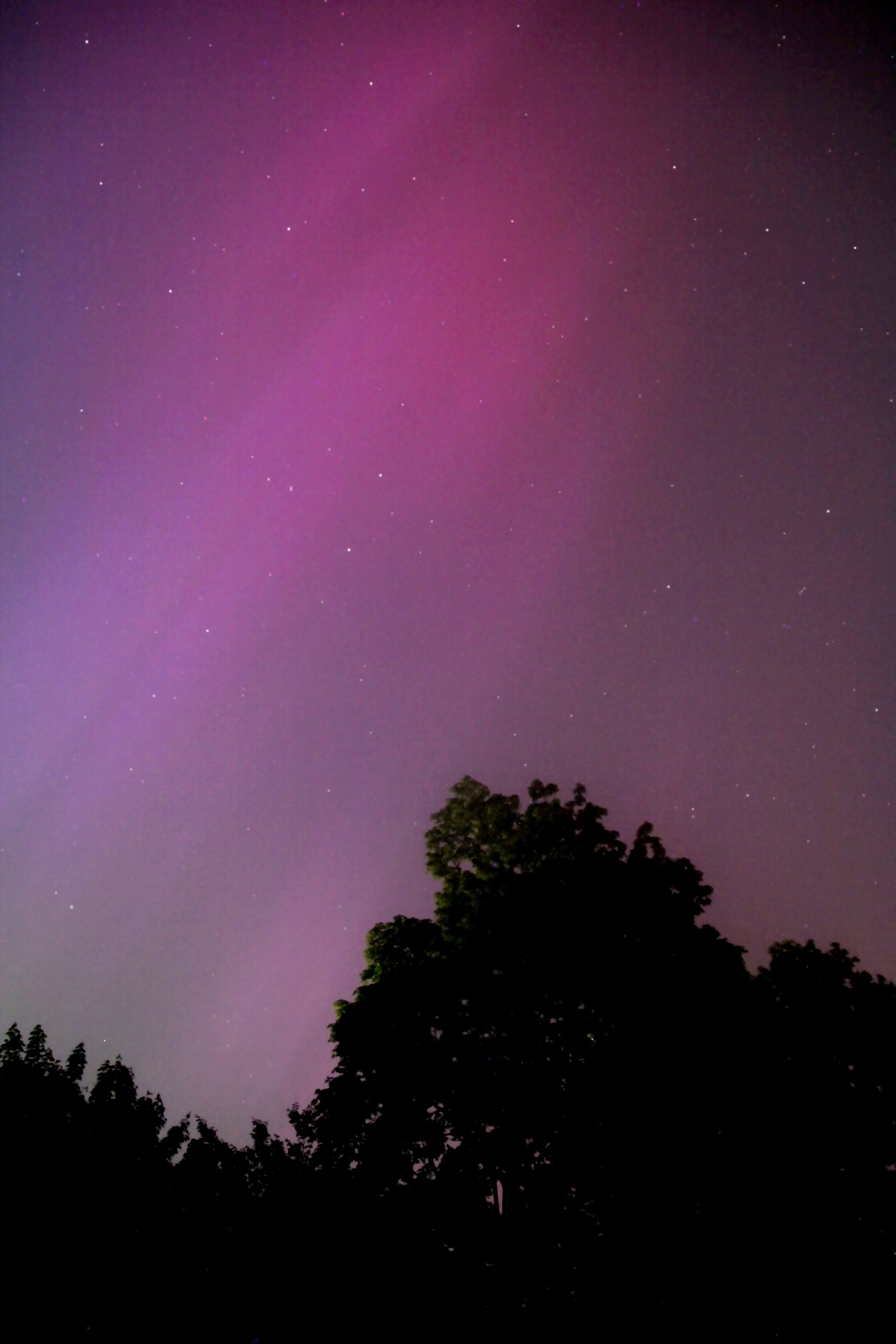
Images of the aurora on the 10th of May 2024 . I have reprocessed them stacking six two and a half second exposures together using Deep Sky Stacker.


Images of the aurora on the 10th of May 2024 . I have reprocessed them stacking six two and a half second exposures together using Deep Sky Stacker.

This image of M13 was taken using my Canon EOS D50 DSLR camera. I set it up at prime focus using my 10 inch f/4.8 reflector, an IDAS filter mounted on a Vixen Atlux mount. I captured 10, 15. 20 and 30 second sub frames with matching dark frames. Total exposure time was 15 minutes. The data was then averaged and stacked using deep Sky Stacker and Paint shop Pro software.

I was using my Canon EOS D50 set at ISO 3200 with an 18mm lens. The exposure times are 2.5 seconds.




Here we have data taken using two telescopes, a 4 inch f/6.3 refractor combined with data taken using a 10 inch f/4.8 reflector.

This group of galaxies lies in the centre of the Markarian chain, the heart of the Virgo cluster. I was using a ten inch F /4.8 reflector, a Vixen Atlux mount, PHD auto guiding , an Atik 383L mono CCD camera and a blue filter for the luminance data. I captured 60 minutes of data using the camera set on X1 bin mode with five minute sub frames and 30 minutes of data with the camera set on X2 bin mode taking 1 minute subframes. This data was then combined together with matching dark frames and flat field frames to reduce the effect of noise and vignetting in the final image. Finally I combined this with old colour data taken using a 4 inch refractor.

The camera was set on ISO 3200 a Cannon 50 D . The lens was set at 18mm a F4 capturing 8 sets of 4 second exposures . I averaged them together and averaged again calibrating the position of the stars due to the rotation of the earth .
Bootes and Corona Borealis


The following images of NC2359. Thor's' Helmet 'was taken on 9 seperate evenings with additional data added, an extra 55 minutes using a blue filter, 1 hour using a H Beta filter and 2.5 hours using an O111 filter. I also used a high pass with an unsharp mask filter to enhance the central detail. Notice the bright star in the centre, a Wolf-Rayet star.
RGB


Hubble Palette

This image of M42 contains old and new data. 30 minutes using RGB filters, 6 hours and 10 minutes using a H A filter, 2 hours and 45 minutes using an O111 filter. 2 hours and 10 minutes using a S11 filter and an additional 60 minutes using a H Beta filter . The data were captured using a 4 inch F/6.3 refractor , a Vixen Atlux mount and an Atik 383L mono CCD camera .

NGC2359 . Thor 's Helmet nebula. This emission nebula lies in the constellation of Canis Major at about 11.000 light years away from us and is about 25 - 30 light years across . I took this image on 4 separate evenings using my 10 inch f/4.8 reflector, a Vixen Atlux mount, PHD auto guiding, a set of Astronomik RGB and narrowband filters , HA. O111 , S11. I captured 5 minute sub frames with matching dark frames and combined them with flat field frames to reduce the effect of noise and vignetting in the final image. The total exposure time was 3 hours 30 minutes using a H A filter, 90 minutes using a S11 filter, 1 hour using an O111 filter and ten minutes using a blue filter. A total exposure time of 6 hours and 10 minutes.

B33. The Horsehead Nebula. This part of the night sky is my favorite. It lies about 1 degree south of the bright star Alnitak the most eastern star on Orion's belt at a distance of 1,500 light years. It is also very challenging to see visually. I can only truly say I have seen once on a very clear moonless night up in the Brecon Beacons national park using a ten inch reflector, a 40mm eyepiece and a Lumicon H Beta filter. However it is not that difficult to image, especially when using narrowband filters, evern in an urban site. The equipment I was using when I was imaging was my 4 inch f/6.3 refractor, a Vixen atlux mount. PHD auto guiding, an Atik 383L mono CCD camera and a set of Astronomik narrowband and RGB filters. I set the camera on X2 bin mode To increase the sensitivity of the camera and captured two minute sub frames. I then combined this data with matching dark frames and flat field frames to reduce the effect of noise and vignetting in the final image. The total exposure time was 1 hour using a blue filter, 1 hour using a H Beta filter, 2 hours and 50 minutes using an O111 filter, 3 hours and 50 minutes using an S11 filter and 13 hours and 7 minutes using a H Alpha filter.
RGB plus narrowband colour