
Tuesday, 8 January 2019
M51 from two cameras
Here we have an image of M51, two images combined using two CCD cameras . The Atik mono 383L and the Atik mono 314 camera. This image reveals the ghost arms of the galaxies.


Sunday, 6 January 2019
NGC4567 and NGC4568 and the Virgo Cluster
NGC4567 and NGC4568. These two galaxies are known as the Siamese twins and lie in the constellation of Virgo. I took this image using my ten inch f/4.8 reflector, a Vixen Atlux mount, PHD auto guiding and an Atik 383L mono CCD camera. I used Astronomik RGB filters with total exposure times of 40 minutes for each filter. The sub frames were five minutes long with matching dark frames combined with flat field frames to reduce the effect of vignetting in the final image.

The Virgo Cluster 2 panel mosaic


The Virgo Cluster 2 panel mosaic

IC1848, the Soul nebula
Here we have another section of the Soul nebula in Cassiopia.
The clouds were moving in fast on this particular evening and I only had 30 minutes of imaging time using an Astronomik H-alpha filter. The colour data however were taken from an old wide angle narrowband image using an 80mm refractor. The luminance data were taken using my ten inch f/4.8 reflector an Atik 383L mono CCD camera with PHD auto guiding. I captured six, five minute subframes with matching dark frames and combined them with flat field frames to reduce the effect of vignetting in the final image.


The clouds were moving in fast on this particular evening and I only had 30 minutes of imaging time using an Astronomik H-alpha filter. The colour data however were taken from an old wide angle narrowband image using an 80mm refractor. The luminance data were taken using my ten inch f/4.8 reflector an Atik 383L mono CCD camera with PHD auto guiding. I captured six, five minute subframes with matching dark frames and combined them with flat field frames to reduce the effect of vignetting in the final image.


Full Size
Monday, 5 November 2018
A 9-section mosaic of IC 1805 using narrowband filters and IC 1871
9 individual panels adding two extra panels to complete the mosaic.
IC1805 the Heart Nebula . This lies in the star constellation of Cassiopeia next to the Soul nebula. I took this image on 7 separate evenings with total exposure times of 60 minutes for each filter . The
telescope I was using was my 10 inch f/4.8 reflector, a Vixen Atlux mount, PHD auto guiding, an Atik 383L mono CCD camera and a set of Astronomik narrowband filters H-alpha, OIII and SII. I captured five-minute sub frames with matching dark frames and combined them with flat-field frames to reduce the effect of vignetting in the final image.
Final mosaic

Stars eroded

Luminance

Final two panels


Mosaic of the 7 panels

Stars eroded

IC 1871 the Soul Nebula . This lies next to the Heart nebula in the star constellation of Cassiopeia the Queen . I took this image on two separate evenings using narrowband filters H-alpha , OIII and SII with total exposure times of sixty minutes for each filter. I captured five minute sub frames with matching dark-frames and combined them with flat-field frames to reduce the effect of vignetting in the final image . This image was taken using my ten inch reflector, a Vixen Atlux mount, PHD auto guiding and an Atik 383L mono CCD camera.


Sunday, 14 October 2018
The outermost region of IC1805
This image of the Heart nebula was taken using my ten inch f/4.8 reflector, a Vixen Atlux mount, PHD auto-guiding and an Atik 383L mono CCD camera.
I captured five minute sub-frames with matching dark-frames and combinded them with flat-field frames to reduce the effect of vignetting in the final image. The total exposure times werw 20 minutes for each R.G.B. colour filter, 40 minutes using SII, 40 minutes using an OIII filter and 60 minutes
using a H-alpha filter.
Full size RGB
Full size Hubble Palette
Full size RGB + Hubble Palette
Sunday, 7 October 2018
A section of sky in the elephant trunk nebula
Here we have another section of sky in the elephant trunk nebula . On this particular evening I had problems with the tracking on the mount and time was very limited . I only had one hour before the telescope would crash into the pier. However I still consider this image as useful.
I was using my ten inch F4.8 reflector, a Vixen Atlux mount and an Atik 383L mono CCD camera. I only used narrowband filters SII, OIII and H-alpha, capturing five-minute sub frames with matching dark frames and combined them with flat field frames to reduce the effect of vignetting in the final image. The total exposure time was limited to 40 minutes using an H-alpha filter, ten minutes using an OIII filter and ten minutes using an SII filter.


I was using my ten inch F4.8 reflector, a Vixen Atlux mount and an Atik 383L mono CCD camera. I only used narrowband filters SII, OIII and H-alpha, capturing five-minute sub frames with matching dark frames and combined them with flat field frames to reduce the effect of vignetting in the final image. The total exposure time was limited to 40 minutes using an H-alpha filter, ten minutes using an OIII filter and ten minutes using an SII filter.
Mosaic image

Full size
Monday, 13 August 2018
IC1318, The butterfly nebula.
I took this image under very clear sky conditions with stars visible down to magnitude five. The telescope I was using was my ten inch f/4.8 reflector with a Vixen Atlux mount and an Atik 383L mono CCD camera. I captured five minute sub frames with matching dark frames and combinded them with flat field frames to reduce the effect of vignetting in the final image. The total exposure times were 60 minutes using a H-alpha filter, 40 minutes using an Olll filter and 40 minutes using a Sll filter.

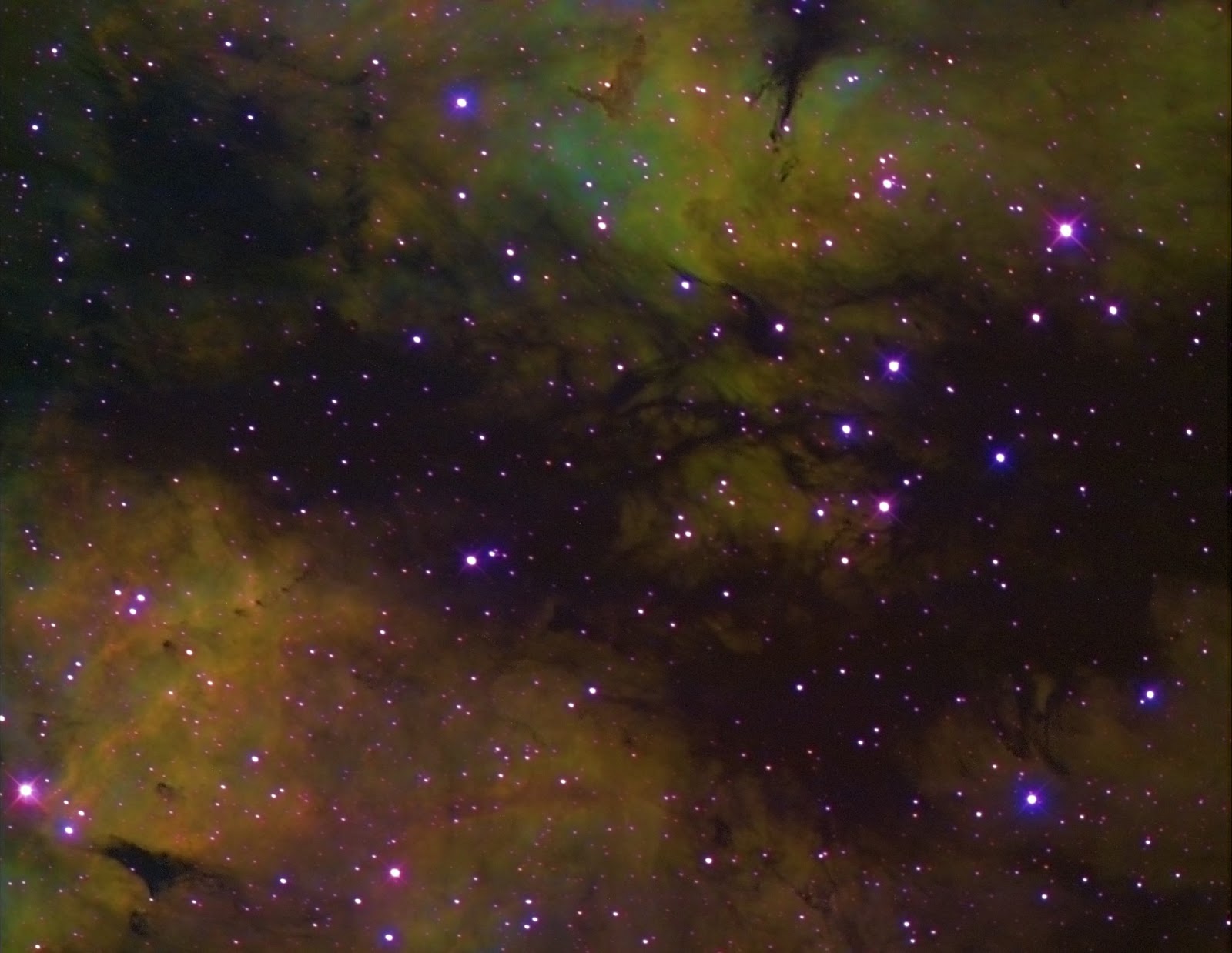


Narrowband Hubble palette
Narrowband Luminance RGB colour
Narrowband plus RGB colour
Tuesday, 7 August 2018
M57 and its outer shell
This image was taken on two separate evenings. On the first I captured the RGB colour data with total exposure times of thirty minutes for each filter . however on the second evening I used a total exposure time of three hours using an Astronomik H Alpha filter . The sky conditions were fairly clear with stars visible down to magnitude 4.5 . I captured five-minute sub-frames with matching dark-frames and combined them with flat field frames to reduce the effect of vignetting in the final image . The telescope I was using was a ten inch f/ 4.8 reflector on a Vixen Atlux mount, PHD auto guiding and an Atik 383L mono CCD camera. Notice the galaxy IC1296 near by M57.


RGB

RGB + H-alpha

RGB + H-alpha cropped
NGC6820 and NGC6823
NGC6820 lies near the star cluster NGC2023 in the constellation of Vulpecula at a distance of about 6,000 light years. I took this image under very clear sky conditions with stars visable down to magnitude five. I was using my ten inch F4.8 reflector, a Vixen Atlux mount, PHD auto guiding and an Atik 383L mono CCD camera. The total exposure times were sixty minutes for each narrowband filter and thirty minutes for each RGB filter. I captured five-minute sub frames and matching dark frames and combined them with flat field frames to reduce the effect of vignetting in the final image.


RGB

Full size
Narrowband Hubble palette

Full size
Narrowband + RGB

Full size
Monday, 4 June 2018
M16 The Eagle Nebula.
From this particular location M16 is low in the night sky and only just rises above the roof tops looking from my observatory, so imaging time is very limited. I only managed to capture two five minute sub-frames using each narrowband (H-alpha, SII and OIII) filters. I then combined the narrow band data with some old H-alpha and RGB luminance data. Using the Hubble palette
colour data to produce the final image. The telescope I was using my ten inch f/4.8 reflector, an Atik 383L mono CCD camera with PHD auto guiding.


colour data to produce the final image. The telescope I was using my ten inch f/4.8 reflector, an Atik 383L mono CCD camera with PHD auto guiding.

M16 Pillars of creation

Narrowband + RGB

Subscribe to:
Posts (Atom)