Monday, 7 October 2019

NGC 2244, NGC 281, IC63, IC1396, NGC 7000, IC5070, IC1848, IC1805.

NGC 2244 data combined using two telescopes a four inch f/6.3 refractor and a 80mm f/6.3 refractor. The total exposure time was ten hours.


NGC 281. This bright nebula lies in the constellation of Cassiopeia the Queen. I was using my 80mm f/6.3 refractor , a Vixen Atlux mount, an Atik 383L mono CCD camera and a set of Astronomik narrowband filters, HA, S11 and O111 . The total exposure time was 5 hours using the HA filter. 1 hour using the S11 filter and 1 hour using the O111 filter. I captured ten minute sub frames with matching dark frames and combined them with flat field frames to reduce the effect of vignetting in the final image.
RGB

Hubble palette

Bicolour

IC63 . This patch of faint nebulosity lies in the constellation of Cassiopeia the Queen. I used my 80mm f/6.3 refractor, a Vixen Atlux mount with PHD auto guiding, an Atik 383L mono CCD camera and a set of Astronomik narrowband filters. I captured ten minute sub frames combined with dark frames and flat field frames to reduce the effect of vignetting in the final image. The total exposure times was three hours using a H Alpha filter, one hour using a O111 filter and one hour using a S11 filter.
Narrowband RGB


Narrowband Hubble palette

Narrowband Bicolour

The Elephant trunk nebula. This nebula lies in the constellation of Cepheus the King. This wide angle image was taken using my 80mm f/6.3 refractor with a Vixen Atlux  mount, PHD auto guiding, an Atik 383L mono CCD camera and a set of Astronomik narrowband filters. I captured ten minute sub frames with matching dark frames and combined them with flat field frames to reduce the effect of vignetting in the final image. The total exposure times was three hours using a H Alpha filter, one hour using a S11 filter and one hour using an O111 filter. The other image however is a composition using three different telescopes, a Ten inch f/4.8 reflector, a four inch f/6.3 refractor and a 80mm f/6.3 refractor. The total exposure time was ten hours.

IC1396

Using 3 scopes

NGC7000 The North American nebula. This lies in the constellation of Cygnus The Swan. This image was taken under full moon light, stars only visible down to magnitude 3.2. I used my f/6.3 80mm refractor, an Atik 383L mono CCD camera, A Vixen Atlux mount with a set of Astronomik narrowband filters. I captured ten minute sub frames with matching dark frames and combined them with flat field frames to reduce the effect of vignetting in the final image . the total exposure times was one hour using a H Alpha filter 40 minutes using an O111 filter and 40 minutes using a S11 filter.

RGB

Bicolour

Hubble palette
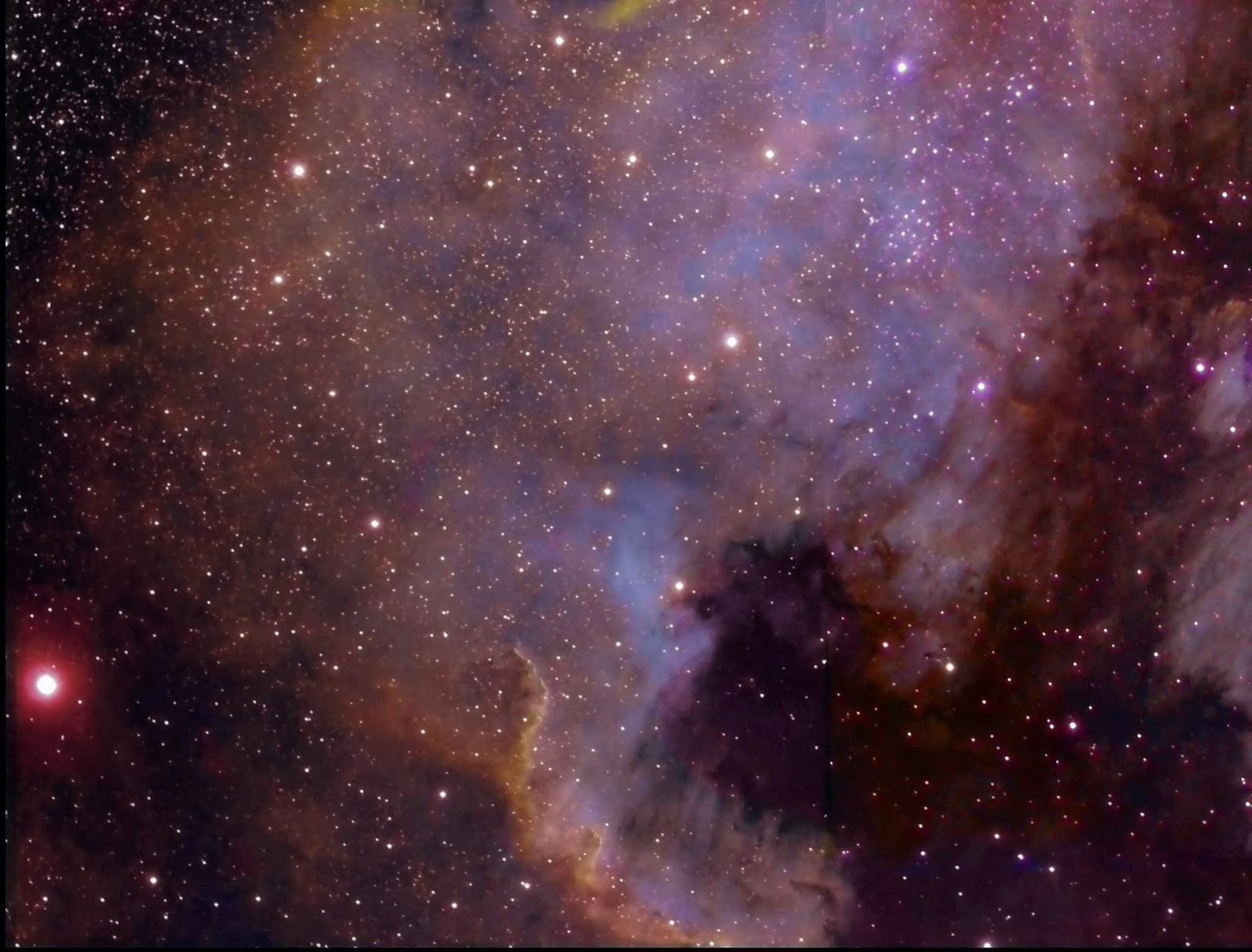
The Pelican nebula, IC5070. This patch of nebulosity lies in the constellation of Cygnus the Swan right next to NGC7000 the North American nebula. I was using my 80mm f/6.3 refractor, a Vixen Atlux mount, PHD auto guiding, an Atik 383L mono CCD camera with a set of Astonomik narrowband filters. I captured ten minute sub frames with matching dark frames and flat field frames. The flat field frames reduces the effect of vignetting in the final image . The total exposure times was 60 minutes for each filter, HA, S11 and O111

North American and Pelican nebulae

Pelican nebula

Pelican nebula Hubble palette, three scopes

IC1848 The Soul Nebula. This lies in the constellation of Cassiopeia the Queen. This image was taken under very clear sky conditions with stars visible down to magnitude 5. The telescope I was using was my 80 mm f/6.3 refractor with an Atik 383L mono CCD camera. The mount I  used was a Vixen Atlux mount with PHD auto guiding. The filters was a set of Astronomik narrowband filters H Alpha, O111 and S11. The total exposure times was 60 minutes for each filter capturing ten minute sub frames with matching dark frames with flat field frames reducing the effect of vignetting.

Hubble palette

IC1805 The Heart Nebula. This lies next to the Soul Nebula in the constellation of Cassiopeia the Queen. I used my 80 mm f/6.3 refractor, a Vixen Atlux mount, PHD auto guiding, an Atik 383L mono CCD camera and a set of Astronomik narrowband filters, HA, S11 and O111. I captured ten minute sub frames with matching dark frames and combined them with flat field frames to reduce the effect of vignetting in the final image. The total exposure times was one hour for each filter.

Bicolour

Hubble palette

Wednesday, 8 May 2019

The Rosette nebula NGC 2244 and IC410 the Tadpole Nebula


Rosette nebula NGC 2244 – Taken under clear sky conditions. Heavy light pollution, stars visible down to magnitude 4.5.
Taken on 3 separate evenings using 80mm f/7 refractor, with focal reducer to f/6.3.Vixen Atlas mount PHD auto guiding Astronomik narrow band filters Sll, 2 hours Olll, 2 hours H-alpha 3 hour exposure. Captured 10 minute sub-frames with matching dark frames combined with flat field frames to reduce the effect of vignetting in the final image. The composition image taken using two telescopes 4” refractor and 80mm refractor total exposure time 9hrs 40 mins


RGB

RGB + Hubble Palette

 Hubble palette


IC410 The Tadpole Nebula. Image was taken under clear sky conditions under bright moonlight. Stars visible down to magnitude 4 so only narrowband imaging was possible . The telescope used was an 80mm refractor with a focal reducer making it F6.3 . Also using a Vixen Atlux mount with PHD auto guiding. The camera was an Atik 383L mono CCD camera with a set of Astronomik narrowband filters S11, One hour Olll, one hour and H-alpha, three hours. I captured ten minute subframes with matching dark frames and combined them with flat field frames to reduce the effect of vignetting in the final image. The composition image however was taken using three separate telescopes a ten inch reflector and a four inch refractor


Hubble Palette

Bi-colour

Three scopes


Sunday, 17 February 2019

The Horsehead and Bubble nebulae

This image of the Horse head is a composition of two images taken through two different telescopes. An 80mm refractor and a 105mm refractor. I was using narrowband filters combined with RGB filters. This image has a total exposure time of twenty hours.


Full size


This image of the bubble nebula in Cassiopeia is a composition of new and old data. The old data have an extra two hours of H-alpha luminance making it a total exposure time of five hours.


Full size


Cropped image


Saturday, 16 February 2019

M78 and Barnards loop

This image was taken on two separate evenings. On the first evening I only had two hours of imaging time before the clouds closed in on me. I set the camera on times two bin mode increasing the sensitivity of the camera. I used my set of narrowband filters H-alpha for 60 minutes, S11 for 30 minutes and O111 for 30 minutes . On the second evening however I set the camera on times 1 bin mode with a total exposure time of three hours using a H-alpha filter. That particular evening I was imaging about 30 degrees from the first quarter moon with mist to content with . Stars were only visible down to magnitude 3.5. The telescope I was using was an 80mm f/7 refractor with a focal reducer and field flattener making f/6.3 . I was using an Atik 383L mono CCD camera, PHD auto guiding and a Vixen Atlux mount. I captured ten-minute sub frames with matching dark-frames and combined them with flat-field frames to reduce the effect of vignetting in the final image. The total exposure time was five hours.

RGB


Hubble palette

RGB + Hubble palette

Thursday, 14 February 2019

Combining images from 3 telescopes

I have combined three images together taken using three different telescopes: A ten inch reflector, A 4 inch refactor and a 3 inch refractor.
Notice how deep the image is. This images were captured using a full set of Astronomick RGB and narrowband filters. The sub-frames ranged from one minute , five minutes and ten minutes, with matching dark frames and flat field frames. The total exposure time was 24 hours and 40 minutes.

3 scopes narrowband luminance, RGB colour


Full size


3 scopes narrowband


Full size


Full size


Thursday, 7 February 2019

The Sword of Orion.

I took this image on three seperate evenings under clear, moonless sky conditions. However I still had inner city lightpollution to contend with; stars visible down to magnitude five. The telescope was my 80mm f/7 refractor with a focal reducer and field flattener making f/6.3. I was also using a Vixen Atlux mount PHD auto-guiding and a set of Astronomik filters. I captured ten minute sub-frames with matching dark frames and combined them with flat field frames to reduce the effect of vignetting in the final image. The total exposure times were 5 hours using a H-alpha filter, one hour using an Olll filter, one hour using an Sll filter and one hour for each RGB filter; making a total exposure time of ten hours.

RGB Colour


Full Size


Bi-Colour, H-alpha and Olll


Full Size


Narrowband, H-alpha, Sll and Olll


Full Size


RGB and Narrowband colour


Full Size


Unsharp masked RGB Narrowband


Full Size


Saturday, 2 February 2019

B33

These images of the Horsehead nebula were taken on five seperate evenings. The exposure times were 9 hours using an Astronomik H-alpha filter, 2 hours using an Olll filter, 2 hours using a Sll filter and
two, 30 minute exposures using green and blue filters. I captured ten-minute sub frames with matching dark frames and combined them with flat-field frames to reduce the effect of vignetting in the final image. The telescope I was using was an 80mm f/7 refractor with a focal reducer and field flattener making f/6.3. I was using an Atik 383L mono CCD camera, PHD auto guiding and a Vixen Atlux mount. I consider this part of the night sky very challenging from inner city light pollution . Notice that I have managed to reveal clouds of nebulosity in the fainter regions. The total exposure time was 14
hours.

RGB colour


Hubble Palette

RGB colour narrowband luminance

Narrowband luminance with narrowband RGB colour

Tuesday, 15 January 2019

The Horsehead region of Orion

The Horsehead region . An Atik 383L mono CCD camera was used. The exposure times were six hours using an Astronomik H-Alpha filter and 30 minutes using green and blue filters, making a total exposure time of 7 hours. The telescope was an 80 mm f/7 refractor with a focal reducer and field-flattener making it f/6.3. I was using a Vixen Atlux mount with PHD auto-guiding. I captured 10 minute sub-frames with matching dark frames and combined them with flat field frames to reduce the effect of
vignetting in the final image.

A work in progress


Stars Eroded


Tuesday, 8 January 2019

M51 from two cameras

Here we have an image of M51, two images combined using two CCD cameras . The Atik mono 383L and the Atik mono 314  camera. This image reveals the ghost arms of the galaxies.


Sunday, 6 January 2019

NGC4567 and NGC4568 and the Virgo Cluster

NGC4567 and NGC4568. These two galaxies are known as the Siamese twins and lie in the constellation of Virgo. I took this image using my ten inch f/4.8 reflector, a Vixen Atlux mount, PHD auto guiding and an Atik 383L mono CCD camera. I used Astronomik RGB filters with total exposure times of 40 minutes for each filter. The sub frames were five minutes long with matching dark frames combined with flat field frames to reduce the effect of vignetting in the final image.


The Virgo Cluster 2 panel mosaic