Tuesday, 28 April 2020

Markarian's Chain

This image was taken under a moonles sky with only light-pollution to contend with.

An 80mm, f/6.3 refractor was used on a Vixen Atlux mount, with PHD autoguiding, an Atik 383L mono CCD camera and a set of Astronomik filters.

Ten-minute sub-frames were captured with matching dark-frames and flat-fields were used to reduce the effect of vignetting in the final image.

The total exposure times were 30min using an OIII filter, 30min using an SII filter and 90min using a H-alpha filter, plus 3 hours using a blue filter.

Markarian's Chain

Closer view

Sunday, 26 April 2020

The Leo Triplet

This image was taken using narrowband filters, H-alpha, SII and OIII. The telescope I was using was an 80mm, f/6.3 refractor.

The scope was mounted on a Vixen Atlux mount. PHD autoguiding was used and the images were captured with an Atik 383L mono CCD camera and a set of Astronomik narrowband filters.

10 min sub-frames were captured with matching dark-frames and they were combined with flat-field frames to reduce the effect of vignetting in the final image.

The total exposure times were 60 min for each filter.

The Leo Triplet

Closer view
Wednesday, 22 April 2020

NGC 1499, The California Nebula

This image was taken using an 80mm, f/6.3 refractor mounted on a Vixen Atlux mount.
PHD autoguiding was used with an Atik 383L mono CCD camera and a set of Astronomik narrowband filters.

The total exposure times were 60 min using an OIII filter, 60 min using a SII filter and 3 hours using a H-alpha filter.

ten minute sub-frames with matching dark frames were captured and they were combined with flat-fields to reduce the effects of vignetting in the final image.

NGC 1499 bi colour

Closer View


NGC 1499 RGB narrowband luminance

Closer View


NGC 1499 Hubble Palette

Closer View


NGC 1499 Hubble Palette plus RGB

Closer view


Tuesday, 21 April 2020

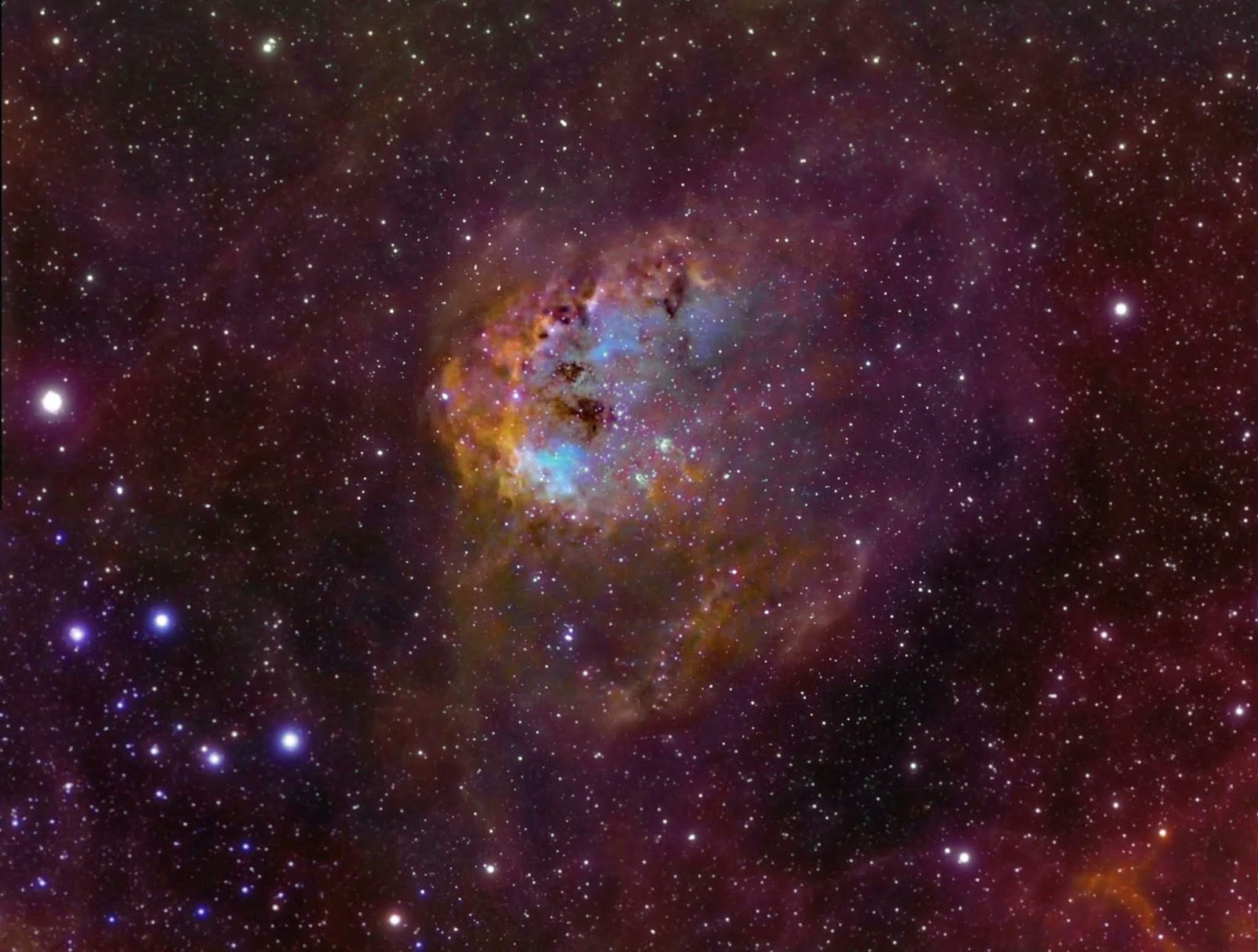
NGC 2264 The Christmas Tree Cluster

The image was taken under moonless sky conditions with only light pollution to contend with.

I was using an 80mm refractor at f/6.3, a Vixen Atlux mount, PHD autoguiding and an Atil 383L CCD camera with a set of Astronomik narrowband filters.

The total exposure times were 40 min using an OIII filter, 40 min using an SII filter and 4 hours using a H-alpha filter.

Ten min sub-frames were captured with matching dark-frames and combined with Flat-fields to reduce the effect of vignetting in the final image.

NGC 2264 Bi-colour image

Closer views


Hubble Palette

Hubble Palette plus RGB

Narrowband luminance, RGB colour


Sunday, 19 April 2020

NGC 2174 The Monkey Head Nebula

The image is a composite of three images taken through three different telescopes; a 250mm reflector, a 102mm refractor and an 80mm refractor.

The total exposure times were 100 min using an OIII filter, 140 min using a SII filter and 180 min using a H-alpha filter. This gives a total exposure time of 7 hours.

NGC 2174 The Monkey Head Nebula

Closer view

Saturday, 18 April 2020

IC 443 The Jellyfish Nebula

This image was taken using an 80mm refractor on a Vixen Atlux mount. PHD guiding was used with an Atik 383L CCD camera and a set of Astronomik narrowband filters.

The total exposure times were one hour for each narrowband filter, SII, OIII, and H-alpha.

I capture 10 min sub-frames with matching dark-frames and used flat-fields to reduce the effects of vignetting in the final image.

Hubble palette

Closer view

RGB

Closer view

Friday, 17 April 2020

M78 and Barnard's Loop

This image was taken under a dark, moonless night, with only light-pollution to contend with.

Stars were visible down to mag 5. The first two evenings, I used total exposure times of 30 min using an SII filter, 30 min using an OIII filter and 4 hours using a H-alpha filter. On the third evening, I used a total exposure time of two hours using a blue filter to reveal the structure of M78.

I was using an 80mm, f/7 refractor on a Vixen Atlux mount, PHD autoguiding with an Atik 383L monochrome CCD camera.

I captured matching dark frames and flat-fields to reduce the effect of vignetting in the final image.

M78 and Barnard's Loop

Closer view

Thursday, 9 January 2020

IC410 &IC 405 The Tadpole nebula and the Flaming star nebula

This patch of nebulosity is deep within the constellation of Auriga the charioteer. I used an 80mm refractor with a focal reducer making it f/6.3. I also used an Atik 383L mono CCD camera, a set of astronomic filters Ha, Sll and 0lll.  I used a Vixen Atlas mount assisted with PHD auto guiding. I captured 10 minute sub-frames and matching dark frames and combined them with flat field frames to reduce the effect of vignetting in the final image.

The two images were taken on separate nights with total exposure times of 60 Minutes for each filter.

Flaming star nebula IC 405

The tadpole nebula IC 410

Mosaic Hubble Palette of IC405 and IC 410

Friday, 13 December 2019

The Crescent and Soap bubble nebulae

 NCC6888  Crescent nebula & soap bubble nebula . This patch of nebulosity lies deep within the constellation of Cygnus the swan. I consider the soap bubble nebula as being a very challenging object from an urban location because of its low surface brightness. I was using a 80mm refractor a Vixen Atlux mount, an Atik 383L mono ccd camera and a set of Astronomik narrowband filters: Sll. Olll and HA. I captured ten minute sub frames with matching dark frames and combined them with flat field frames to reduce the effect of vignetting in the final image. The total exposure times was 1 hour and 20 minutes using an Sll filter. I hour and 30 minutes using a Olll filter, and 4 hours 30 minutes using a HA filter. This data was taken on 2 separate evenings the first was a clear, moonless night, the second under a clear quarter moon.

The Crescent and Soap bubble nebulae


Soap bubble nebula

C 1318 The Butterfly Nebula

IC 1318 The Butterfly Nebula. This patch of nebulosity lies in the star constellation of Cygnus the Swan.

I was using my 80mm F7 refractor, a Vixen Atlux mount and an Atik 383L mono CCD camera . The filters was a set of Astronomik narrowband filters . Ha. S11 and O111. I captured ten minute sub frames and combined them with dark frames and flat field frames to reduce the effect of vignetting in the final image. The total exposure times were sixty minutes for each filter.